Why Scene Coordination Starts Before Patient Care Begins
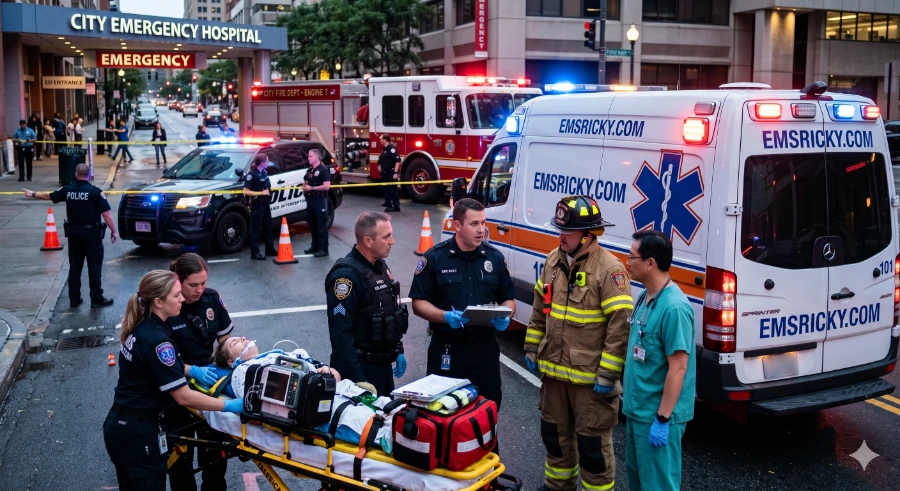
A serious emergency rarely belongs to one responder group. A crash may involve EMS, fire rescue, law enforcement, dispatch, towing, and hospital staff. Each partner sees a different part of the same problem. EMS may focus on breathing, bleeding, shock, pain, and transport decisions. Fire crews may handle hazards, access, stabilization, lighting, and extrication. Law enforcement may control traffic, crowds, scene threats, and evidence concerns. Hospitals may prepare staff, rooms, equipment, and specialty resources before arrival. Good coordination connects those moving parts before patient care becomes isolated.
New providers sometimes treat scene coordination as basic teamwork. Stronger providers see it as a clinical safety skill. The patient benefits when agencies share the same operating picture. Confusion often starts small, with repeated questions, unclear parking, or delayed hospital notification. Those small gaps can grow during noise, pressure, and competing priorities. EMS clinicians improve the scene by managing both care and information. They do not need to control every decision to influence the outcome.
Scene Coordination Belongs in EMS Training
Interagency coordination becomes easier when providers practice communication, role awareness, scene safety, and handoff habits before the call. Ricky Rescue’s EMT program and advanced EMS training options help students connect field decisions with the teamwork expected on active scenes.
- Builds early awareness of command structure, patient access, and scene safety.
- Connects clinical priorities with fire, law enforcement, dispatch, and hospital roles.
- Supports clearer handoffs when patient care moves from field to emergency department.
The Shared Operating Language: NIMS, ICS, and Unified Command
Emergency scenes need structure before they need speed. The National Incident Management System gives agencies a common framework for coordinated response. The Incident Command System helps responders organize tasks, roles, resources, and decisions. EMS clinicians use that structure even without holding a command title. They should know who has command and what hazards affect access. They should also know which agency controls each operational risk. That awareness prevents crews from acting on assumptions. It also reduces conflict when clinical urgency meets scene-control priorities.
What Unified Command Looks Like on Scene
Unified Command helps multiple agencies coordinate without erasing their own responsibilities. Fire may lead rescue, stabilization, hazard control, and access. Law enforcement may lead security, traffic flow, crowd movement, and evidence protection. EMS may lead triage, treatment, transport priority, and medical communication. A hospital may prepare a trauma room, respiratory support, imaging, or specialty response. Those roles should meet inside one shared plan. The patient suffers when those roles compete instead of connect. Unified Command gives everyone a practical way to move in the same direction.
Command Awareness Without Ego
Good EMS coordination does not require loud authority. It requires clear information at the right moment. A crew can say, “We have one critical patient and need access now.” That sentence helps command without challenging fire, police, or other partners. EMS may lead clinical decisions while fire controls the physical space. Police may delay entry until a threat changes. Mature providers recognize those boundaries and still advocate for the patient. Command awareness turns urgency into useful action.
Turn Scene Awareness Into a Training Path
Providers who want stronger scene judgment often need more than memorized protocols. The application process page helps students review the next steps for EMS training, while paramedic-track learners can compare options for deeper field leadership and advanced patient care.
Working With Fire: Safety, Access, Extrication, and Movement
Fire crews often create the conditions that make EMS care possible. They may stabilize a vehicle, force entry, ventilate a space, or control fire risk. They may also provide lifting support, lighting, and safer movement paths. EMS should treat those tasks as part of patient care. A trapped patient may need airway support before full access exists. A bleeding patient may need rapid contact during a technical rescue. Fire and EMS must exchange information during that narrow window. Rescue priorities improve when clinical urgency and physical access stay connected.
Where Fire and EMS Communication Breaks Down
Breakdowns often happen when crews assume shared priorities. EMS may want rapid movement before fire completes stabilization. Fire may start movement before EMS finishes a critical intervention. Both groups may use familiar terms that the other side reads differently. Recent research on ambulance, fire, and police collaboration found that teamwork depends on communication, leadership, and role understanding. The study also identified radio issues, limited joint practice, and unclear assumptions. A simple fix starts with naming the next action. “We need thirty seconds for airway positioning” can prevent a rushed move.
Working With Law Enforcement: Security, Access, and Boundaries
Law enforcement often shapes whether EMS can safely reach a patient. Officers may manage violent scenes, weapons concerns, traffic, crowds, or family conflict. EMS remains patient-centered, but safety decisions may start outside medical control. Staging can frustrate providers who want immediate patient contact. That pause still protects the crew, the patient, and nearby bystanders. Police may also manage evidence concerns during criminal incidents. EMS should avoid unnecessary disturbance when patient care allows it. Life threats still demand immediate care under local protocols and medical direction.
Clear Language During Unclear Scenes
Unclear scenes require direct operational questions. EMS should ask whether the scene supports safe entry. Crews should ask where to position the ambulance and stretcher. They should confirm whether movement creates a safety or evidence concern. Those questions do not weaken clinical judgment. They help each agency share what it knows. Police may see risks that EMS cannot see from the curb. EMS may see medical urgency that officers cannot judge from distance. Professional language protects safety, privacy, and patient care at once.
Roadway Incidents: The Everyday Test of Coordination
Roadway incidents test interagency coordination on ordinary days. Federal Traffic Incident Management guidance treats these scenes as planned, multidisciplinary events. The goal includes responder safety, patient safety, motorist safety, traffic flow, and secondary-crash prevention. That wider frame helps EMS think beyond the stretcher. Passing traffic, rain, curves, darkness, and distracted drivers create ongoing danger. A patient may survive the original crash while responders face new risks. Strong coordination reduces that exposure. EMS crews support that goal through smart positioning, fast updates, and timely transport decisions.
| Training data point | Reported figure | Why it matters for EMS coordination |
|---|---|---|
| National TIM Responder Training completions | More than 800,000 responders by October 2025 | Roadway response requires shared training across several disciplines. |
| EMS responder community training level | 31% TIM trained as of December 31, 2022 | EMS crews still have room to build traffic-scene coordination skills. |
| Law enforcement responder community training level | 43% TIM trained as of December 31, 2022 | Traffic control and patient access improve through common response practices. |
A Crash Scene Is Not Only a Medical Scene
New EMS clinicians often see the patient first and the roadway second. Experienced crews learn to see both at once. The patient needs assessment, treatment, packaging, and transport. The roadway needs protection, flow control, and quick clearance. Fire, police, transportation teams, towing operators, and dispatch affect the same outcome. A poorly placed ambulance can block access or increase exposure. A well-placed unit can protect responders and speed movement. Roadway coordination turns scattered activity into safer patient care.
Practical Scene Choices for EMS Crews
EMS crews should park for safety before convenience. They should confirm whether fire or police created a protected work area. Patient movement should match traffic control and extrication timing. Crews should avoid unnecessary repositioning once the scene develops. Early updates matter when patient count, entrapment, or priority changes. Dispatch may need more ambulances, fire units, or law enforcement support. The hospital may need earlier activation. Safe quick clearance means reducing avoidable delay after essential care finishes.
Interoperable Communication Means More Than Better Radios
Better equipment helps, but it cannot fix poor habits. Interoperable communication depends on shared procedures, trained users, plain language, and routine practice. Agencies need clear talk paths before a high-stress call exposes weakness. EMS crews should know which channel command uses and when to switch. They should also know how to communicate when systems fail. A clear message still fails when responders lack a shared process. The best communication plan combines technology with disciplined behavior.
The Skills Behind the Equipment
EMS should use plain language when several agencies share the scene. Codes and discipline-specific shorthand can confuse mixed responder groups. Crews should separate confirmed facts from assumptions. They should announce hazards, patient count, resource needs, and destination changes early. Critical instructions deserve a repeat-back. Short messages work best when every word serves a purpose. Long radio traffic can block urgent updates from other responders. A calm voice can improve the scene without raising volume.
Why Joint Training Matters
Joint training builds familiarity before a real incident exposes weakness. Scenarios should include noise, interruptions, delayed access, and conflicting priorities. Fire, police, EMS, dispatch, and hospital teams should practice together when possible. Familiarity makes real scenes less mysterious. After-action reviews should examine where information stalled. They should also identify language that helped or confused. Coordination improves when teams study the process, not just the outcome.
Communication Habits That Prevent Scene Drift
Scene drift happens when responders act from different mental pictures. One group thinks the patient can move immediately. Another group sees an unresolved hazard. A third group assumes transport has already started. Small gaps can grow into serious delay. EMS can reduce drift through meaningful updates, role confirmation, and calm correction. A brief status report can reset the shared picture. The goal is not more talking, but better-timed talking.
Closed-Loop Communication Without Sounding Robotic
Closed-loop communication means a message travels both ways. One person gives an instruction or update. The receiver confirms the message in clear terms. The sender then knows the message landed correctly. This habit helps during medication preparation, lifting, extrication, and handoff. It also helps when agencies coordinate traffic movement or patient access. A provider might say, “Move on three, head leads.” A partner can answer, “Head leads, moving on three.”
Role Confirmation in the First Minute
The first minute often shapes the rest of the call. EMS should identify command and confirm the safety picture. Crews should know who handles patient care, radio traffic, and hospital contact. They should also know who controls traffic, access, or crowd movement. Two responders may assume the other called the hospital. Nobody may update command after finding a second patient. A simple role check keeps those gaps visible. Students perform better when tasks have names.
Hospital Coordination Begins Before Arrival
Hospital coordination starts before the ambulance reaches the bay. The receiving team needs time to prepare rooms, staff, equipment, and specialty resources. EMS gives that time through an accurate prearrival report. The report should match urgency without exaggeration. AHRQ PSNet summarizes a record review of 90 EMS-to-ED handoffs involving critically ill and injured patients. The summary noted that essential information often disappeared during transfer. Noise, interruptions, and competing priorities make omissions more likely. Structured communication helps crews protect details that guide immediate care.
The Prearrival Report Is Not the Full Handoff
The prearrival report helps the hospital prepare. It does not replace the bedside handoff. The bedside handoff transfers immediate clinical context and responsibility. The written or electronic report preserves details for continuity. A radio report should stay short and actionable. A bedside report should clarify trends, treatments, and current concerns. Documentation should capture facts that may matter after the call ends. Strong providers select what the receiver needs at that exact moment.
What Hospitals Need From EMS
Hospitals need the patient story in a usable sequence. Age, chief complaint, mechanism, and mental status create the first frame. Vital signs and trends show improvement or decline. Treatments and response show what changed before arrival. Crews should include allergies, medications, history, and special needs when known. Scene information can also matter. A hazardous exposure, violence concern, contamination issue, or pediatric mechanism may affect preparation. The report should include those factors without drifting into irrelevant detail.
Structured Handoff Tools: SBAR, MIST, ISBAR, and IMIST-AMBO
Structured handoff tools help crews organize information under pressure. SBAR, MIST, ISBAR, and IMIST-AMBO give providers a path through the report. They do not replace clinical judgment. They reduce omissions when teams practice them consistently. MIST works well for trauma because it centers mechanism, injuries, signs, and treatment. SBAR organizes situation, background, assessment, and recommendation. ISBAR adds identification during busy receiving conditions. IMIST-AMBO expands trauma handoff with allergies, medications, background, and other clinical needs.
When a Mnemonic Helps
A mnemonic helps when the receiving team recognizes the format. It works best when EMS uses it repeatedly during training. It should keep the report concise and complete. It should not force irrelevant information into a rigid script. The tool matters less than consistent use. A crew that changes formats every call creates confusion. A hospital team that interrupts every report weakens the process. Shared expectations make the tool useful.
What the Evidence Supports
Research supports structured communication as a safety tool. Reviews of SBAR show moderate evidence for patient-safety improvement, especially in telephone communication. Trauma handover research also supports structure, training, and team attention. The evidence does not support one universal magic phrase. EMS educators should teach mnemonics with judgment. A report should highlight what threatens life or changes immediate care. Extra detail belongs in documentation or follow-up conversation. The best handoff sounds organized, brief, and clinically honest.
The Human Factors Behind Missed Information
Good responders can miss information during chaotic scenes. Noise, fatigue, adrenaline, weather, hierarchy, and interruptions all affect attention. Different agencies may use different words for the same problem. Busy teams can act from partial information without noticing the gap. Trauma handover research identifies disruptions and inconsistent frameworks as recurring problems. It also highlights limited formal training and collaboration barriers. EMS can counter that pressure through checkbacks, structured reports, and role confirmation. Better habits make good people more reliable under stress.
Practical Habits EMS Students Can Build Early
EMS students should treat coordination as a clinical skill. It affects assessment, safety, treatment timing, destination decisions, and transfer of care. The classroom offers a safe place to practice these behaviors. Students can rehearse command contact, role assignment, and resource requests. Scenario instructors can add noise, interruptions, and changing information. Handoff drills should include interruptions from a receiving team. Students need practice recovering without losing the report. Strong communication needs repetition before adrenaline arrives.
During and After the Call
On arrival, EMS should identify command and confirm safety. Crews should share patient count, acuity, hazards, and resource needs early. They should ask for clarification before acting on assumptions. During treatment, they should keep updates brief and factual. After the call, crews should ask where information moved clearly. They should also identify where information stalled. That review should focus on repeatable improvements, not embarrassment. A missed update can become a future training point.
What Better Coordination Protects
Better coordination protects patients, responders, bystanders, and receiving teams. It reduces duplicated work, missed information, unsafe movement, and avoidable delay. It also helps EMS act as part of a broader healthcare system. Modern EMS work extends from dispatch through hospital handoff. The best clinicians treat communication as patient care. They know when to speak, what to share, and how to confirm. They respect fire, law enforcement, dispatch, hospitals, and other partners. Their work helps the entire response move safely, clearly, and intelligently.

Jeromy VanderMeulen is a seasoned fire service leader with over two decades of experience in emergency response, training, and public safety management. He currently serves as Battalion Chief at the Lehigh Acres Fire Control & Rescue District and is CEO of the Ricky Rescue Training Academy, a premier provider of online and blended EMT and firefighter certification programs in Florida.
Jeromy holds multiple degrees from Edison State College and the Community College of the Air Force, and is pursuing his MBA at Barry University. He maintains top-tier certifications, including Fire Officer IV, Fire Instructor III, and Fire Inspector II, and has served as a subject matter expert for a court case. He is a member or the Florida Fire Chiefs Association.
Jeromy also contributes to state-level fire safety regulation and serves on several hiring and promotional boards.