Modern EMS education is changing because live call exposure, by itself, cannot guarantee that every student will see the same critical patients, practice the same decision points, or be evaluated under the same conditions. The current CoAEMSP interpretations of the 2023 CAAHEP standards require a structured progression through didactic instruction, laboratory work, clinical experiences, field experiences, and capstone field internship, which confirms that accredited EMS education is built around a blended competency model rather than a “ride along and hope you see enough” model.
That shift matters because modern programs are expected to produce entry-level clinicians who can demonstrate readiness, not just report hours or patient contacts. The NHTSA EMS Education Pipeline describes current EMS education as a system that can use multiple approaches, including simulation, to determine competency across didactic, lab, clinical, field, and capstone phases, which shows that simulation is now part of the national conversation about how competence gets measured.
For students, instructors, and employers, the real question is no longer whether simulation belongs in EMS education. The better question is what simulation does best, what real calls still teach better, and how a strong program combines both without pretending they are interchangeable. That is where modern EMS education is moving, and it is where thoughtful programs now separate simple exposure from real preparation.
Why live calls alone are no longer enough
Real calls still matter, but they do not offer a uniform educational experience. One student may see multiple respiratory failures, behavioral emergencies, and cardiac cases during field time, while another may spend the same number of hours on low-acuity transports or uneventful standby periods. A recent rapid evidence review on ambulance placements for student paramedics describes those placements as essential, yet also notes that their quality and consistency are shaped by outdated workplace practices, personal factors, education-industry barriers, and the unpredictable nature of prehospital care.
That inconsistency creates a serious training problem. Exposure is not the same thing as mastery, and being present on a call does not automatically mean the student assessed the patient well, prioritized correctly, communicated clearly, or led care under pressure. The current CoAEMSP standards interpretations reflect that reality by requiring programs to document progression and competency rather than treating simple attendance as proof of readiness.
This issue becomes even more important with low-frequency, high-risk events. Pediatric deterioration, airway compromise, scene safety threats, and rapidly evolving medical emergencies do not appear on a predictable schedule for every student. The current NAEMSP discussion of situational awareness in EMS education reinforces that complex scene awareness, anticipation, and cognitive load management must be taught deliberately because field experience alone does not always provide consistent learning opportunities.
Programs also face a fairness issue when they rely too heavily on whatever the shift happens to provide. Two students can complete the same number of hours and leave with very different levels of practice in patient assessment, leadership, scene management, and time-sensitive decision-making. Modern EMS education is changing in part because competency-based training cannot treat luck as a curriculum design strategy.
What simulation training adds
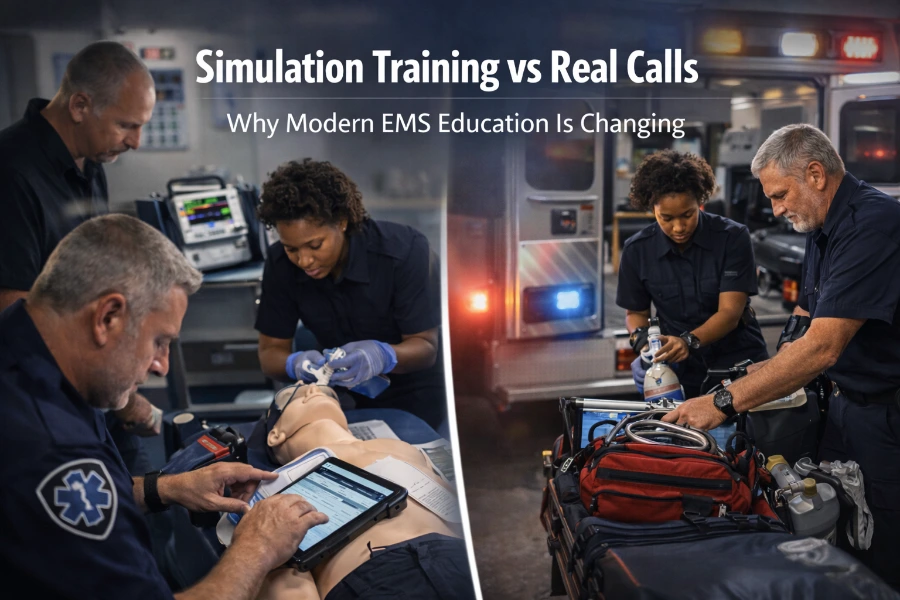
Simulation gives EMS programs something live calls often cannot provide: repeatability. A critical scenario can be built, run, paused, debriefed, corrected, and run again until the student improves. That makes simulation especially useful for situations where instructors want every learner to practice the same assessment sequence, leadership behaviors, or time-sensitive intervention pathway. Current EMS competency guidance also recognizes that simulation can augment supervised patient encounters in clinical and field settings when live exposure is limited or inconsistent.
That does not mean every simulation center or every mannequin produces equal results. It means simulation has earned a legitimate place inside EMS education when used for specific purposes: deliberate practice, controlled evaluation, rare-case exposure, and structured debriefing. The NHTSA EMS Education Pipeline supports that broader use by acknowledging simulation as one of the approaches programs may use in determining competency across the education continuum.
The peer-reviewed literature supports that role, even when the strongest papers remain careful in their conclusions. A UCLA-hosted paper on paramedic instructor perspectives regarding clinical and field placements also underscores that placement quality can vary widely, which helps explain why structured simulation has become more important in modern training design. That is an important fact-check point: the current evidence strongly supports simulation as useful and established, but it does not justify inflated claims that simulation alone solves every readiness problem in EMS training.
Simulation also helps programs teach non-technical skills more deliberately. Clinical judgment in EMS is not limited to memorizing protocols or starting IV lines. It includes anticipating patient deterioration, recognizing scene threats, managing cognitive load, and communicating under stress. In NAEMSP’s 2024 discussion of situational awareness in EMS education, the authors state that there is no substitute for experience, while also arguing that EMS education can and should teach anticipation and scene-risk recognition in complex scenarios.
Debriefing is one of the biggest reasons simulation matters. A live call may teach a hard lesson, yet the scene rarely pauses long enough for instructors to unpack every decision, missed cue, and communication breakdown in real time. Simulation creates that instructional pause. Students can see where their thinking drifted, where they lost the overall picture, and how earlier choices changed the final outcome.
What real calls still teach better
None of that makes real calls obsolete. Field experience still teaches things that simulation cannot fully replicate. Real scenes bring unpredictable family dynamics, cramped spaces, bystander pressure, incomplete histories, distracting noise, uncertain access, delayed backup, and the emotional weight of a living patient who may not follow a script. That is one reason the CoAEMSP interpretations still preserve required field and capstone components rather than replacing them with simulation.
Real calls also test whether training transfers under friction. A student may perform well in a scenario lab but struggle when the home is dark, the family is upset, the stretcher access is poor, and the patient story keeps changing. The evidence on ambulance placements does not argue that field time should disappear. It argues that field learning is indispensable, but uneven in educational yield unless it is supported by strong supervision, thoughtful program design, and structured feedback.
Capstone internship remains especially important because this is where leadership has to become real. The current standards framework makes clear that this phase occurs after core didactic, laboratory, and clinical experiences are complete, and it is the point where the student must function in the prehospital environment in the role of team leader. That requirement makes it clear that simulation can prepare students for leadership, but the field still tests whether that leadership holds up in practice.
Real calls also teach emotional steadiness in a way that simulated urgency can only approximate. A student is not just managing a protocol on scene. The student is managing uncertainty, family emotion, environmental discomfort, interrupted thinking, and the pressure of knowing that the patient in front of them is not a training device. That burden is part of professional formation, and it remains one of the strongest reasons field experience still matters.
This table helps readers compare where simulation training adds structure and where real calls add field-tested judgment. It also supports the article’s main point that modern EMS education is changing toward a blended model, not a replacement model.
| Training Area | What Simulation Training Does Well | What Real Calls Do Well | Why It Matters in Modern EMS Education |
|---|---|---|---|
| Rare high-risk cases | Allows repeated practice of pediatric crises, airway failure, cardiac arrest leadership, and other low-frequency scenarios. | May expose students to authentic patient reactions and scene complications, but case availability is unpredictable. | Programs cannot rely on chance exposure alone when students must show competency in critical events. |
| Skills repetition | Creates repeatable scenarios where errors can be corrected and rerun during the same training cycle. | Offers real patient variation, but most calls cannot be paused, repeated, or reset for another attempt. | Repetition improves consistency and helps programs document progressive learning rather than isolated exposure. |
| Performance evaluation | Supports structured evaluation of assessment sequence, communication, prioritization, and leadership behaviors. | Shows how the student performs under operational pressure, but evaluation may vary by preceptor and case type. | Competency-based education needs consistent assessment methods alongside live field validation. |
| Scene complexity | Can simulate distractions, family presence, time pressure, and scene hazards in a controlled environment. | Delivers true unpredictability, imperfect information, cramped spaces, bystander pressure, and emotional realism. | Students need controlled preparation first, then real-world exposure to test adaptability under friction. |
| Team leadership | Lets students rehearse delegation, closed-loop communication, and treatment sequencing before entering internship. | Tests whether the student can actually lead care with working crews in live prehospital conditions. | Leadership should be introduced in simulation and confirmed during capstone field internship. |
| Student equity | Helps ensure every student encounters key scenarios, even when local call volume differs. | Exposure depends heavily on shift timing, location, patient mix, and service environment. | Modern programs use simulation to reduce training gaps caused by uneven field opportunity. |
| Safe failure and debriefing | Allows students to make mistakes, receive immediate feedback, and repeat the scenario without patient harm. | Provides powerful lessons, but real calls offer limited room for error and fewer opportunities for controlled replay. | Deliberate debriefing strengthens clinical judgment before students carry greater real-world responsibility. |
Why the best programs blend both models
The most accurate comparison is not “simulation versus real calls.” It is “what does each method do best, and how should modern programs combine them.” Simulation is strongest when programs need consistency, repetition, targeted correction, and controlled exposure to rare or high-stakes events. Real calls are strongest when students need to adapt to uncertainty, communicate with actual patients and families, and manage operational realities that cannot be fully scripted. The current accreditation and competency framework supports that blended view rather than an either-or model.
That blended approach also fits the broader move toward competency-based education in healthcare. A broader healthcare education literature base supports the view that simulation can improve learning experience and clinical competency, while also carrying limits related to realism, cost, and faculty requirements. That balance matters. The fact-checked position is not that simulation is perfect. It is that simulation gives educators a more deliberate way to build and assess performance before students are expected to manage real prehospital care with increasing independence.
The strongest programs also sequence those methods well. Students usually need controlled practice before high-stakes unpredictability, and they need guided feedback before they are expected to perform with greater autonomy. A program that blends both models thoughtfully is not trying to replace reality. It is trying to prepare students for reality before the consequences become real.
A practical way to judge an EMS program
One useful way to evaluate a modern EMS program is to ask whether it follows a progression of exposure, repetition, transfer, and proof. Exposure means students are introduced to core scenarios, skills, and decision points in a structured way. Repetition means they can revisit important cases, correct errors, and strengthen weak spots rather than hoping the same issue appears again by chance in the field.
Transfer means the student can carry those lessons from the lab into real patient care when noise, time pressure, and incomplete information disrupt clean decision-making. Proof means the program does not stop at participation hours or skill checklists. It requires students to demonstrate that they can assess, prioritize, communicate, and lead at the level expected for entry into practice. That four-part lens offers a more useful standard than asking only how much ride time a student will get.
That matters because students often shop for programs using the wrong benchmark. They ask how many calls they will see, how many hours they will log, or how quickly they can finish. Those questions are understandable, but they are incomplete. A stronger question is whether the program can show a credible pathway from supervised practice to repeatable performance and then to real-world leadership under pressure.
Why this supports Ricky Rescue’s philosophy
For a program aligned with Ricky Rescue’s training philosophy, the strongest evidence-backed message is not that simulation replaces the street. It is that modern EMS education works best when it uses structured scenarios, repeated skills practice, meaningful debriefing, supervised clinical learning, and real field development in the right order. That position fits the current CoAEMSP and NHTSA framework and avoids claims that the evidence does not support.
This matters for students because many future EMTs and paramedics still assume that more ride time automatically means better preparation. Current standards and recent literature point to a more precise truth. A strong program must do more than expose students to calls. It must create a system where they can practice, fail safely, improve with feedback, and then prove that those lessons transfer to real patients in real environments.
That is also the kind of philosophy employers tend to value. Services need graduates who can enter the field with a workable assessment framework, disciplined communication habits, and enough practiced judgment to keep learning safely on real calls. Programs that blend simulation with field development are better positioned to produce that kind of graduate than programs that depend too heavily on variable ride-time exposure alone.
The clearest conclusion
Modern EMS education is changing because random call exposure alone cannot guarantee competence. Simulation gives programs a reliable way to standardize practice, teach rare high-risk scenarios, and measure student performance more consistently, while real calls remain essential for judgment, leadership, and adaptation under real-world pressure. The strongest current evidence supports a blended model, and that is exactly why the industry is moving in this direction.
Frequently Asked Questions
Is simulation training better than real calls in EMS education?
Neither one is better in every situation, which is exactly why modern EMS education uses both. Simulation is better for repetition, structured correction, rare high-risk cases, and consistent evaluation across an entire class. Real calls are better for testing judgment in uncontrolled environments where patient emotion, scene friction, noise, access problems, and shifting information complicate even simple decisions. The strongest programs do not force a false choice between the two; they use simulation to build performance and field experience to confirm that performance under real pressure.
Why can’t ride time alone prove that a student is ready for EMS practice?
Ride time shows exposure, but exposure does not guarantee competence. Two students can complete the same number of hours and see very different patient types, decision points, and leadership opportunities based on luck, timing, geography, and call volume. A student may also be present on a difficult call without truly leading the assessment, forming priorities, or managing the scene. That is why modern programs increasingly focus on whether the learner can repeatedly demonstrate sound assessment, communication, prioritization, and leadership rather than simply logging hours.
What kinds of EMS skills are taught especially well through simulation?
Simulation is especially useful when educators need every student to practice the same high-stakes scenario in a controlled way. That includes pediatric deterioration, airway compromise, cardiac arrest leadership, scene awareness, communication under stress, and other events that may not appear predictably during field rotations. It also works well for teaching decision-making sequences that need repetition, immediate correction, and replay. A strong simulation session does more than test memory; it reveals how a student thinks, reacts, communicates, and recovers from error.
What do real calls teach that even strong simulation cannot fully reproduce?
Real calls teach adaptability under genuine uncertainty. Students must process incomplete histories, family emotion, cramped environments, distracting noise, delayed resources, changing patient conditions, and the emotional weight of caring for a real person who may not respond the way a scenario predicts. Those variables force students to move beyond controlled performance and show whether their training holds together when the situation becomes messy. That is why field experience remains indispensable, even in programs that use simulation well.
How can a student tell whether an EMS program uses simulation the right way?
A strong program treats simulation as part of a larger competency pathway, not as a flashy add-on. Students should look for repeated scenario practice, instructor-led debriefing, progression from basic to complex cases, clear performance expectations, and a direct connection between simulation work and later field responsibilities. It is also worth asking whether simulation prepares students for leadership, communication, and scene management instead of focusing only on isolated technical skills. Good simulation should make the transition to live patient care more deliberate, not more artificial.
What questions should a future EMT or paramedic ask before choosing a program?
A useful starting point is to ask how the program moves students from exposure to proof. Ask how often students repeat critical scenarios, how instructors debrief errors, how field placements are supervised, how leadership is evaluated, and how the program determines readiness beyond attendance and patient contacts. It also helps to ask how students are prepared for rare but dangerous events they may not encounter during normal ride time. Those questions reveal much more about training quality than a simple promise of more hours on an ambulance.
Why does the blended model matter so much for patient care?
The blended model matters because patient safety depends on more than familiarity with protocols. New clinicians need repeated practice before they are expected to act under pressure, yet they also need real-world experience before anyone can trust that their performance transfers beyond the lab. Simulation helps reduce training gaps, while live fieldwork tests whether those lessons survive confusion, time pressure, and emotional stress. When programs combine both methods well, students enter practice with more consistent preparation and a stronger foundation for safe decision-making.
Sources used in the article
The core sources behind this article are the current CoAEMSP interpretations of the 2023 CAAHEP standards, the NHTSA EMS Education Pipeline, the rapid review on ambulance placements for student paramedics, the NAEMSP discussion of situational awareness, and the UCLA-hosted paper on placement quality in paramedic education.

Jeromy VanderMeulen is a seasoned fire service leader with over two decades of experience in emergency response, training, and public safety management. He currently serves as Battalion Chief at the Lehigh Acres Fire Control & Rescue District and is CEO of the Ricky Rescue Training Academy, a premier provider of online and blended EMT and firefighter certification programs in Florida.
Jeromy holds multiple degrees from Edison State College and the Community College of the Air Force, and is pursuing his MBA at Barry University. He maintains top-tier certifications, including Fire Officer IV, Fire Instructor III, and Fire Inspector II, and has served as a subject matter expert for a court case. He is a member or the Florida Fire Chiefs Association.
Jeromy also contributes to state-level fire safety regulation and serves on several hiring and promotional boards.