
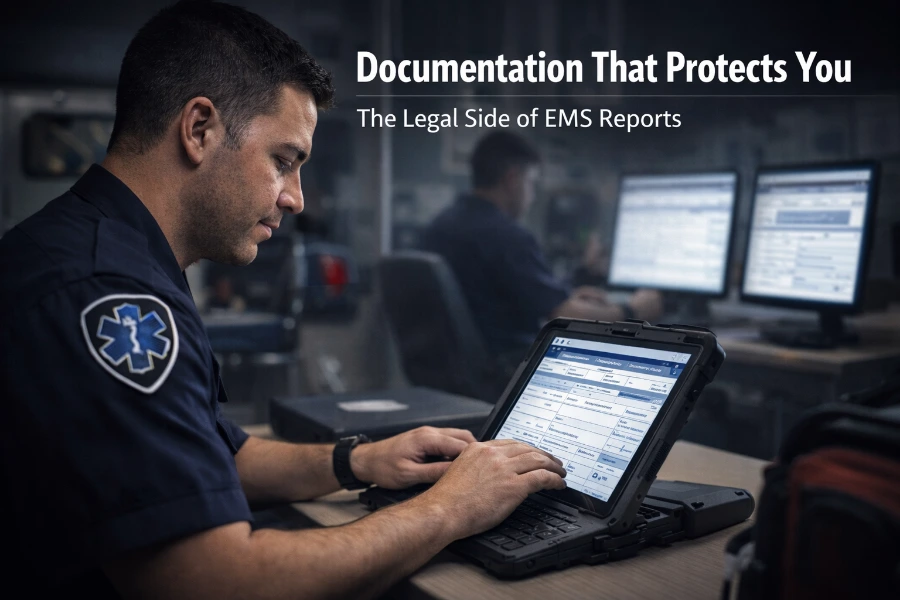
Why the PCR Carries More Weight Than Many Crews Realize
The patient care report does far more than summarize a call. It follows the patient into the next phase of care, and it may later shape billing decisions, internal reviews, or legal scrutiny. A rushed narrative can leave dangerous gaps, even when the crew delivered solid care. Strong documentation protects patients first, and it also protects the people who treated them. That makes the PCR more than a task to finish before the next call. It is the written version of the crew’s clinical judgment, communication, and professionalism.
One chart, several audiences
An EMS report rarely stays inside the ambulance service. Emergency department staff may read it first, yet supervisors, auditors, insurers, and attorneys may study it later. Each reader looks for different details, and each reader notices different weaknesses. That broad audience explains why clear charting matters not only for crews, but for the healthcare professionals who continue the patient’s care. A strong report gives each of those readers the same clear story rather than forcing each one to reconstruct events from fragments.
Why weak wording creates strong problems
Loose wording often creates trouble long after the shift ends. Memory fades quickly, especially after several high-acuity calls, yet the report remains fixed. A vague phrase can force others to guess what the crew saw, thought, or explained. Guesswork hurts credibility, and credibility often decides how a disputed call gets judged. Once credibility weakens, even reasonable care can start to look uncertain. That is why wording discipline matters as much as form completion.
What Makes an EMS Report Legally Important
The EMS report often becomes the most complete record of the encounter. It captures what the crew found, what the patient said, what decisions followed, and what risks were discussed. Courts, regulators, and agency leaders value contemporaneous records because they preserve events before hindsight reshapes them. That legal weight gives every line of the report practical importance. It also means omissions can matter as much as what appears on the page. Silence in the wrong place can suggest that a key assessment or warning never happened.
The record often outlives the call
A difficult chart may resurface months after the crew forgets the patient’s name. Complaint investigations, payment disputes, and poor outcomes can revive an otherwise ordinary call. At that point, the report carries most of the story by itself. Good documentation gives the crew a durable memory when their own memory no longer helps. That durability matters because later reviewers rarely see the scene, the time pressure, or the ambiguity crews managed in real time. They see the chart and judge the call through that lens.
If it is not documented, it becomes harder to defend
Care that never appears in writing becomes much harder to prove. A crew may have discussed serious risks, reassessed symptoms, or advised transport several times. Those efforts lose value later when the report barely mentions them. The legal issue often turns on proof, and proof begins with the chart. Documentation does not need to be defensive to be protective. It needs to be specific enough that another professional can understand what happened without filling in gaps on the crew’s behalf.
The Four Legal Pressures That Shape EMS Documentation
Several legal forces shape the way a strong EMS report should read. Liability concerns matter, yet privacy rules, payment requirements, and licensure oversight also influence what belongs in the chart. A professional report anticipates those pressures without sounding defensive. That balance separates protective documentation from paperwork that merely fills space. The best narratives sound clinical, grounded, and restrained because they focus on observable facts and documented reasoning rather than on self-protection as a writing style.
Liability and negligence claims
Negligence reviews usually focus on recognition, judgment, and communication. Investigators want to know whether the crew identified serious warning signs and acted on them. They also examine whether the report shows reassessment, evolving findings, and clear decision-making. A short narrative can look careless even when the treatment itself was reasonable. Legal review rarely rewards shorthand that only insiders understand. It rewards a record that makes the crew’s process visible from the first patient contact through final disposition.
HIPAA and lawful information sharing
Privacy law supports treatment, and it does not block proper handoff communication. EMS crews may share relevant findings with receiving clinicians for treatment purposes. The report should still handle private information carefully and avoid careless disclosure outside appropriate channels. Good documentation respects both privacy and continuity of care. That means including clinically relevant facts while avoiding unnecessary detail that adds exposure without adding value.
Billing, audits, and payment disputes
Many crews think legal risk means malpractice alone, yet billing documentation creates another serious exposure point. Payment reviewers examine medical necessity, transport justification, signatures, and internal consistency. Federal compliance data now show that insufficient documentation accounted for 63.5% of improper payments for ambulance services during the 2024 reporting period. That financial pressure gives documentation a second legal life beyond the patient encounter. A chart can therefore fail even when the clinical care was acceptable if the written record does not support why the service was medically necessary and how the encounter unfolded.
Licensure, agency review, and disciplinary scrutiny
Licensing boards and agency leaders often judge conduct through the report. A chart that sounds careless can raise concerns about judgment, professionalism, or honesty. That scrutiny does not require a lawsuit or catastrophic outcome. Agencies often spot patterns through documentation before they see them anywhere else. Repeated thin refusals, repeated contradictions, or repeated missing reassessments can signal a bigger performance problem. The chart therefore functions as both a patient record and a professional record.
The current record around EMS documentation shows why crews now face pressure from several directions at once. The snapshot below highlights the claims and standards that matter most for this topic.
| Live finding | What it means for EMS reports | Why it matters |
|---|---|---|
| CMS reported a 13.2% ambulance improper payment rate, with insufficient documentation driving 63.5% of those errors. | Narratives must support necessity, level of service, and internal consistency. | Weak charting can create direct reimbursement and compliance exposure. |
| HHS permits ambulance disclosure to hospitals for treatment. | Crews can document and relay clinically relevant information during handoff. | Clear handoff records support continuity while staying inside lawful disclosure rules. |
| State oversight tools still review refusal forms and PCR accuracy. | Refusals and non-transports need stronger documentation than routine calls. | Thin wording can fail both legal and regulatory review. |
| Current protocols still direct providers to chart observations thoroughly and objectively. | Narrative tone and precision remain core quality markers. | Credibility often rises or falls on wording rather than on form completion alone. |
| The national ePCR framework continues evolving under the NEMSIS data standard. | Structured fields now serve care, reporting, and system analysis at once. | Templates help with consistency, yet they still require sound narrative judgment. |
The Parts of a Report That Most Often Protect or Expose a Crew
Certain sections of the chart do more legal work than others. Opening observations, focused assessment details, reasoning, and reassessment often decide whether the record feels trustworthy. Templates help crews stay organized, yet templates cannot rescue thin thinking or rushed wording. The narrative still carries the burden of explanation. Readers may forgive brevity on a straightforward call, but they rarely forgive a missing clinical thread on a refusal, a deterioration, or a complaint-driven review. The safest report shows a visible chain from scene findings to decisions and outcome.
Dispatch context and scene arrival details
The beginning of the report sets the frame for everything that follows. Dispatch information, scene conditions, bystander reports, and the crew’s first impressions explain why the encounter unfolded the way it did. Those details also show whether later actions made sense in context. A report that starts vaguely often stays vague all the way through. Good opening context also helps later readers understand whether information was limited, conflicting, or evolving at the time. That can matter greatly when a hindsight review expects certainty that the crew did not yet have.
The patient presentation the crew actually found
Labels such as stable or uncooperative reveal very little. Readers need observable facts such as posture, speech, skin signs, work of breathing, distress level, and mental status cues. Specific description shows the patient as the crew found them, not as the template expected them. That distinction can matter greatly in disputed cases. It also reduces the risk that a narrative sounds conclusory rather than clinical. The more the chart relies on direct observation, the more durable it becomes.
Assessment findings, including relevant negatives
A strong assessment does not list positives alone. Relevant negatives often show that the crew considered dangerous possibilities and looked for them deliberately. Chest pain without shortness of breath, trauma without loss of consciousness, or dizziness without focal deficit each tells part of the story. Those negatives reveal clinical discipline rather than checkbox completion. They also help explain why a crew chose a lower-acuity impression, recommended transport, or accepted a refusal. Without them, the reader cannot tell whether the crew ruled concerns out or simply failed to address them.
Clinical reasoning, not just checkboxes
Checkboxes record actions, yet they rarely explain judgment. Good narratives show why the crew chose transport, recommended evaluation, called medical control, or accepted a refusal. Readers should understand the thought process without needing to invent one. Clinical reasoning turns documentation from a form into a defensible record. That does not require lengthy essays. It requires short, clear lines that connect findings, concern level, recommendation, and patient decision.
Interventions, patient response, and reassessment
Treatment matters, yet response to treatment matters just as much. A report should show what changed after oxygen, medication, repositioning, or reassurance. Reassessment also proves that the crew continued paying attention rather than performing a single snapshot exam. That timeline often carries legal value because it shows ongoing care. It also helps later clinicians understand whether the patient improved, plateaued, or worsened before handoff. A chart that records only what was done without what happened next leaves the clinical story half-finished.
Refusals and Non-Transport Calls Deserve Their Own Standard
Refusal and non-transport encounters demand a higher level of discipline. The patient remains in the community, the final outcome may worsen, and the report becomes the primary evidence of what EMS did. Thin wording leaves room for later claims that the patient never understood the danger. Protective refusal documentation must show more than a signature. It must show a meaningful process. That process includes assessment, communication, patient understanding, and the practical circumstances shaping the decision.
Why refusal cases generate disproportionate risk
A transported patient reaches another layer of medical care. A refusing patient leaves with the original problem, plus the risk of deterioration. That difference increases later scrutiny when the condition worsens. That risk becomes even sharper when the refusal involves symptoms that may signal evolving medical emergencies. Reviewers often return to the same questions in these cases: what did the crew suspect, what did the crew explain, and what evidence shows the patient understood the stakes. A thin refusal narrative usually fails that test.
Capacity is not a checkbox
Orientation alone does not settle capacity. A person may answer basic questions correctly and still misunderstand risk, fail to appreciate consequences, or struggle with intoxication, pain, fear, or language barriers. The report should show how the crew judged the patient’s understanding in real context. Capacity documentation must describe thinking, not just recite a formula. The strongest narratives show the patient’s responses, the crew’s explanation of risks, and any factors that may have limited reliable decision-making. That approach reads far more credibly than a bare statement that the patient was alert and oriented.
What a defensible refusal discussion actually shows
A protective refusal narrative explains the concern that prompted EMS involvement. It records the key findings, the risks the crew discussed, and the recommendation the patient declined. It should also capture the patient’s own words or response showing understanding. That dialogue often matters more than the signature box. A useful refusal note also shows what alternatives were offered, what return precautions were given, and whether family, caregivers, or medical control influenced the discussion. Those details show process rather than mere formality.
Family pressure, intoxication, language barriers, and gray-zone calls
Refusal decisions grow harder when outside pressures affect the patient. Family members may push for transport or, just as often, push against it. Alcohol, drug use, fear of cost, language mismatch, and social confusion can all distort consent. The chart should acknowledge those realities and show how the crew worked through them carefully. A strong narrative does not ignore friction around the decision. It explains how the crew addressed it, what remained uncertain, and why the final disposition occurred.
A practical test for refusal narratives
One useful standard is a simple four-part check: concern, capacity, communication, and choice. The chart should show what worried the crew, how understanding was evaluated, what specific risks were discussed, and what the patient then chose. That framework keeps the narrative organized without making it sound scripted. It also helps crews avoid the common mistake of documenting the signature while under-documenting the conversation that made the signature meaningful. Refusal reports become much stronger when those four parts appear clearly and in sequence.
Signatures Matter, but They Do Not Fix a Weak Narrative
Signatures help support the record, yet they do not substitute for substance. Many poor charts include a valid signature and still fail under review. The signature confirms participation in the process more than it confirms understanding. The narrative must still carry the legal weight. That remains true whether the chart involves transport consent, billing forms, or refusal paperwork. A signed page without a clear story still leaves the hardest questions unanswered.
What a signature does prove
A patient signature may show that a discussion occurred and that the patient participated in the decision. It can also support identity and acknowledgment of the disposition. That evidence has real value, though it remains limited. Reviewers still ask what the patient understood, what the crew explained, and why refusal seemed informed. Those questions live in the narrative, not in the signature field. A strong report therefore treats the signature as support for the record rather than as the record itself.
When the patient cannot sign
Some patients cannot sign because of illness, injury, weakness, or altered condition. In those moments, documentation needs extra care rather than less care. Staff statements, witness details, and receiving-facility confirmation can become important support for the record. The chart should make the inability to sign easy to understand from the facts presented. It should also describe what alternate confirmation was used and why. A missing signature without a clear explanation can create avoidable suspicion even when the reason was legitimate.
Handoff Documentation Can Protect Care and Reduce Disputes
A good handoff protects both care continuity and later credibility. It shows that the crew transferred essential information to the next clinician at the right time. That record can matter when delays, omissions, or conflicting stories emerge later. Handoff documentation closes the loop on prehospital care. It also reduces the chance that the EMS narrative feels unfinished. A chart that ends with treatment but never clearly records transfer of care can raise questions that are easy to prevent.
Who received report, what was shared, and when
The report should identify who accepted handoff and what major information the crew communicated. Critical findings, interventions, response to treatment, and major concerns belong in that summary. Timing also matters because delays can affect both outcomes and blame. A short line documenting handoff can answer large questions later. It can also help reconcile discrepancies between an EMS timeline and a hospital timeline. That becomes important when later review focuses on sequence rather than on diagnosis alone.
Verbal handoff versus written handoff
The spoken handoff and the written report should tell the same story. Small differences happen, yet major contradictions damage trust quickly. A verbal report that sounds urgent followed by a written narrative that sounds routine creates obvious tension. Consistency helps everyone believe the record. The goal is not perfect word-for-word duplication. The goal is agreement on the patient’s presentation, the crew’s concerns, the interventions provided, and the condition at transfer.
Narrative Quality Still Decides How the Report Reads Under Scrutiny
The quality of the writing often shapes how the care gets perceived. Strong medicine can look weak when the chart sounds rushed, sarcastic, or imprecise. Good charting does not require fancy prose or legal jargon. It requires restraint, clarity, and disciplined observation. Readers should come away with confidence that the writer noticed what mattered and reported it honestly. Tone, precision, and sequencing often influence that impression more than any single dramatic sentence.
Objective language beats emotional language
Emotional wording rarely helps the crew. Terms that mock, judge, or editorialize can make the writer appear biased or defensive. Current protocol language still directs providers to document observations thoroughly and objectively on the patient care report. That tone strengthens credibility during any later review. Objectivity also protects the patient because it keeps the focus on observed facts rather than on frustration or assumptions. The best narratives sound calm even when the scene was chaotic.
Specific beats vague
Vague documentation leaves readers with impressions rather than facts. Saying the patient looked ill tells far less than describing pallor, diaphoresis, shallow respirations, and delayed responses. That standard matters across the field, whether the report follows a basic call, a transfer, or care delivered by BLS for healthcare providers. Precision protects better than generalities. Specific wording also helps later readers distinguish between a mild concern, a high-risk presentation, and a changing patient. General labels rarely do that work well enough.
Timelines matter more than many crews think
Many disputes revolve around sequence rather than diagnosis. Readers want to know when symptoms began, when findings changed, when treatment occurred, and when transport decisions happened. A strong timeline turns scattered events into a coherent account. That structure helps the report survive close questioning. It also prevents a common weakness in rushed narratives where important actions appear but the order never becomes clear. Sequence often explains judgment, and judgment is what later review tries to reconstruct.
The ePCR Standard Is More Structured Than It Used to Be
Modern paramedic documentation now serves individual care and larger system needs at once. Standardized data elements support quality review, research, reimbursement, and public health tracking. That structure improves consistency across services and states. The narrative still matters deeply because standardization cannot explain judgment by itself. Structured fields tell reviewers what happened in a coded format. The narrative tells them why those events mattered in the context of that call.
Standardized fields improve consistency but do not replace judgment
Structured fields help crews capture essentials reliably. They make missing vitals, times, and dispositions easier to spot during review. Clinical thinking still lives outside those fields, especially when the call feels ambiguous or unstable. Judgment must appear in the narrative where readers can follow it. A complete ePCR therefore needs both disciplined field entry and a readable narrative spine. When either piece is weak, the report becomes less useful and less defensible.
Why templated charts still fail
A templated report can look complete while leaving core questions unanswered. Readers may see every required field completed and still wonder why the crew accepted a refusal or downgraded the urgency. Overreliance on templates can flatten unusual calls into generic text. Protective documentation must sound like this patient, not every patient. That means the narrative should carry the features that made the encounter clinically or legally important. Templates support consistency, but they should never erase the individuality of the call.
Common Documentation Failures That Create Avoidable Exposure
Most documentation failures do not involve dramatic misconduct. They usually grow from habit, fatigue, autopilot writing, or overconfidence in shorthand. Those ordinary mistakes can still create major exposure later. Prevention begins with recognizing the patterns. Once crews know what commonly weakens a chart, they can build small habits that improve quality without making every report unnecessarily long. Strong documentation is often the product of disciplined routines rather than of dramatic writing talent.
Copy-forward habits and cloned wording
Copied phrases save time in the moment, yet they can undermine trust quickly. Repeated wording across different calls may suggest the writer documented from memory rather than from observation. Small inaccuracies also spread easily when crews reuse old text. A chart should sound rooted in the actual encounter. Clone-style language becomes especially risky when a later reviewer compares multiple reports from the same provider. Repetition that looks efficient to the writer can look careless or misleading to everyone else.
Missing reassessments after treatment
Care without reassessment looks incomplete. Readers want to know whether pain changed, breathing eased, mental status improved, or deterioration continued. A missing reassessment can make active treatment seem performative rather than thoughtful. Follow-up findings show the crew stayed engaged after the intervention. Reassessment also helps explain why transport urgency changed, why additional treatment was or was not given, and why the patient condition at handoff looked different from the initial presentation. It is often the bridge between action and clinical meaning.
Contradictions inside the same report
Internal inconsistencies damage a chart faster than almost any other flaw. A calm narrative paired with alarming vitals, or a refusal narrative paired with absent risk discussion, raises immediate questions. State compliance tools still review treatment/transport refusal forms and whether patient care reports are completed accurately. Contradictions create openings for doubt that crews often cannot close later. Even small inconsistencies can snowball during review because they suggest the writer was not fully in control of the record. A clean chart keeps its facts aligned across narrative, vitals, times, and disposition fields.
Overconfidence in vague shorthand
Shorthand may feel efficient among coworkers, yet outsiders may read it very differently. Unsupported abbreviations, local slang, and loose conclusions often age poorly under formal review. Clear plain language travels better across hospitals, auditors, and legal settings. Simple wording protects better than insider code. The safest chart still sounds professional, but it avoids making the reader decode the meaning. Every extra layer of interpretation gives later reviewers more room to question what the crew actually intended to say.
What Current Oversight Trends Suggest About Risk in 2026
Documentation now sits at the center of several oversight trends. Payment integrity programs examine records more closely, and professional discussions continue focusing on refusal capacity and informed decision-making. That environment rewards crews who explain their reasoning carefully. It also punishes thin charting more quickly than in earlier eras. The practical lesson is simple: documentation quality now affects clinical credibility, operational stability, and financial integrity at the same time. Crews can no longer treat charting as a secondary skill.
Documentation is now a payment-integrity issue, not just a legal issue
Chart quality now affects agency revenue as directly as it affects legal defensibility. Auditors look for support of transport level, medical necessity, signatures, and internal consistency. A weak report can trigger financial loss even when no complaint ever appears. That reality makes documentation a frontline operational issue. Services that ignore that shift place pressure on crews and billing teams alike. The report now needs to stand up clinically and administratively.
Capacity, refusals, and defensibility remain live professional concerns
Refusal documentation continues evolving because the underlying problem remains difficult. Capacity often changes with pain, intoxication, stress, fatigue, fear, and social pressure. Professional debate keeps returning to the same lesson: simple labels do not capture informed refusal well. Crews need a richer record when patients decline care. That richer record does not require theatrical language. It requires concrete documentation of understanding, discussion, and context.
Building a Report That Can Stand on Its Own Months Later
The best EMS report serves the patient in the moment and the crew long afterward. It explains what happened, why the crew acted as it did, what the patient understood, and how care transferred or ended. Strong documentation does not exaggerate, and it does not hide uncertainty. It presents a clear, honest account that another reader can follow without guesswork. A useful way to think about that goal is to ask whether the chart could defend itself if the crew were no longer available to explain it. That is the practical standard a durable PCR should meet.
Write for the person who was not there
A strong chart assumes the next reader knows nothing about the call. That reader needs scene context, patient presentation, reasoning, key discussions, and the final handoff or refusal details. Writing with that outsider in mind improves clarity immediately. It also makes the record far more durable under scrutiny. Reports become safer when they answer the obvious follow-up questions before anyone has to ask them. That habit reduces ambiguity without making the narrative bloated.
The safest chart is clear, complete, and restrained
Protective documentation does not sound dramatic or self-congratulatory. It sounds factual, organized, specific, and calm. Crews protect themselves best when they describe what they observed, explain what they did, and show how the patient responded. A report built that way can stand on its own when memory cannot. That remains the most reliable legal strategy because it is also the best clinical strategy. A clear report protects care, credibility, and the people connected to both.

Jeromy VanderMeulen is a seasoned fire service leader with over two decades of experience in emergency response, training, and public safety management. He currently serves as Battalion Chief at the Lehigh Acres Fire Control & Rescue District and is CEO of the Ricky Rescue Training Academy, a premier provider of online and blended EMT and firefighter certification programs in Florida.
Jeromy holds multiple degrees from Edison State College and the Community College of the Air Force, and is pursuing his MBA at Barry University. He maintains top-tier certifications, including Fire Officer IV, Fire Instructor III, and Fire Inspector II, and has served as a subject matter expert for a court case. He is a member or the Florida Fire Chiefs Association.
Jeromy also contributes to state-level fire safety regulation and serves on several hiring and promotional boards.