Recertification can look simple on paper and still create stress in real life. In Florida, EMTs and paramedics often manage renewal tasks around shift work, family schedules, agency training, and card expirations. The U.S. Bureau of Labor Statistics notes that EMTs and paramedics often work full time, some work more than 40 hours per week, and schedules may include nights, weekends, and holidays. That kind of schedule makes deadline-only planning risky. A year-round continuing education plan gives renewal work a structure before pressure builds.
Plan CE Around the Credential That Expires First
A recertification plan works best when providers separate state renewal, National Registry requirements, and provider cards before choosing coursework. EMS Ricky’s application process page can help students and working providers review next steps before training deadlines become rushed.
- List Florida, National Registry, employer, and card-based deadlines separately.
- Match each course to the exact requirement it needs to satisfy.
- Save completion records immediately instead of rebuilding proof later.
Why Recertification Pressure Builds Before the Deadline
Most renewal stress does not come from one difficult course or one confusing form. It usually grows from small delays that stack together over months. A provider may finish a course but forget to save the certificate. Another provider may complete hours that feel useful but do not match the needed category.
Real EMS life makes those gaps easier to miss. A 24-hour shift can erase a planned study night. A mandatory agency class can land during the same week as family obligations. A provider may also assume that a card renewal, state renewal, and National Registry requirement all follow the same timeline. That assumption can leave one credential clean and another one exposed.
A practical plan treats recertification like equipment readiness. The goal is not to cram hours into the final month. The goal is to know the requirement, schedule the right course, save the proof, and verify the record before renewal week arrives.
Know Which Requirement You Actually Need to Meet
The first useful step is sorting the requirements into separate buckets. Florida certification, National Registry status, employer training, and BLS, ACLS, or PALS cards can all matter, but they do not always renew together. One course may support more than one requirement, yet no provider should assume that without checking the details. A clean plan starts by naming the exact credential or course card at risk.
Florida renewal has its own checklist
The Florida Department of Health states that current EMT and paramedic certificates expire at midnight Eastern Time on December 1, 2026. Florida also lists a completed renewal application, required fees, and a 30-hour refresher course that includes two hours in pediatric emergencies. That pediatric requirement deserves early attention because providers often leave pediatric topics until the final stretch. A Florida-focused CE plan should place the refresher and pediatric hours near the center of the schedule, not near the end.
National Registry follows a category-based model
The National Continued Competency Program organizes continuing education into national, local or state, and individual components. The model lists total continuing education requirements as 16 hours for EMR, 40 hours for EMT, 50 hours for AEMT, and 60 hours for paramedic recertification. That structure matters because a provider can collect hours and still miss a category. Florida providers who maintain National Registry status should compare both systems before choosing any course.
Renewal Planning Often Starts With the Right Provider Card
Many providers track state and National Registry requirements while also watching BLS, ACLS, or PALS expiration dates. If your next deadline involves basic resuscitation training, EMS Ricky’s BLS course page gives a focused starting point.
Build the CE Calendar Backward
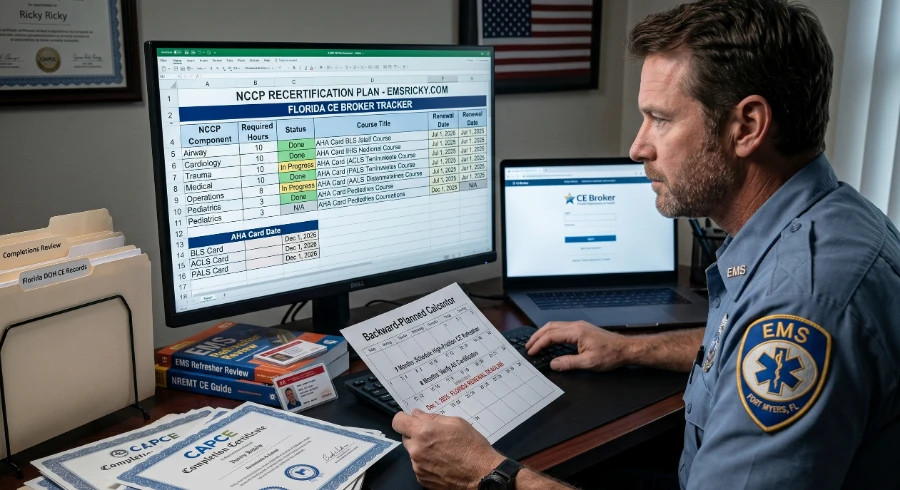
A low-stress plan starts with the deadline, then moves the work earlier. The provider should list Florida certification expiration, National Registry expiration, employer deadlines, and healthcare-provider card dates in one place. The earliest date controls the first planning window. This method prevents the common problem of finishing one requirement while another one quietly expires.
| Timing | Best Action | Practical Reason |
|---|---|---|
| 12 months before renewal | Confirm state, national, employer, and card-based requirements. | This shows every deadline before schedules get crowded. |
| 9 months before renewal | Choose refresher, skills, or instructor-led courses that need scheduling. | These courses may have limited seats or fixed dates. |
| 6 months before renewal | Check completed CE records and saved certificates. | Missing records still leave time for correction. |
| 3 months before renewal | Fill category gaps instead of taking random hours. | This prevents wasted time on courses that do not solve the problem. |
| 30 to 45 days before renewal | Verify documentation and submit renewal materials. | The final window should focus on confirmation, not new discovery. |
Twelve months before renewal, the provider can confirm requirements and create a simple CE tracker. Nine months out, high-friction training should move onto the calendar, especially refresher courses, instructor-led sessions, skills days, and card renewals. Six months out, the provider should check reported records instead of relying on memory. That review can catch a missing certificate before it turns into a renewal problem.
The final 30 to 45 days should focus on verification rather than learning new requirements. A provider who waits until the final week may still finish the course but struggle with reporting, portal access, or documentation. Early completion gives the provider time to solve those problems without risking renewal status. The calendar does not remove the work, but it changes the work from urgent to manageable.
Pick Courses by Category, Not Panic
A provider who waits too long often shops for hours instead of solutions. That creates risk because recertification systems care about categories, documentation, and approval, not just seat time. A course title may sound relevant without fitting the requirement that remains unfinished. Category planning helps providers choose education with a purpose.
A simple tracking chart can prevent confusion:
| Course Completed | Date | Provider | Hours | Requirement Bucket | Certificate Saved? |
|---|---|---|---|---|---|
| Refresher or CE course | MM/DD/YYYY | Provider name | 30 | Florida, National Registry, employer, BLS, ACLS, or PALS | Yes or no |
The requirement bucket should stay specific. “CE” alone does not tell the provider whether the course solved a Florida renewal issue, a National Registry category gap, or a card renewal need. A paramedic who needs cardiology and pediatric education should not choose the easiest available course only because it fits a day off. A few minutes of planning can prevent hours of misplaced effort.
Use Online and Hybrid CE Wisely
Online continuing education can help shift-based EMS providers avoid deadline pressure. A provider who works rotating shifts may need flexible coursework during quiet off-duty hours. Another provider may prefer scheduled hybrid training because live instruction and defined deadlines add accountability. The best format depends on the requirement, the deadline, and the provider’s real schedule.
Flexibility still requires verification. A convenient course only helps when it satisfies the requirement the provider needs. Course pages should clearly explain format, hours, completion requirements, and documentation. Providers should also save proof immediately after completion instead of assuming the record will remain easy to find later.
A Cleaner CE Plan Starts Before Enrollment
Before choosing a course, providers should know whether they need a refresher, a provider-card renewal, or a broader training step. That order keeps CE planning tied to the credential instead of the course calendar.
- Check whether the requirement involves Florida renewal, National Registry, or employer policy.
- Confirm whether the missing item requires live skills, online coursework, or documentation review.
- Keep certificates, completion dates, and requirement categories in one renewal folder.
Providers comparing advanced training can also review EMS Ricky’s paramedic courses when recertification planning overlaps with career advancement.
Keep Records Cleaner Than You Think You Need To
Recordkeeping deserves the same attention as course selection. A provider can complete the right course and still create stress by losing the certificate or failing to check the reported record. Course title, provider name, completion date, hours, and approval details should go into one folder immediately. That folder should also include screenshots or PDFs when a course portal shows completion status.
A clean record system works best when providers update it during the year, not during the renewal window. After each course, the provider should save the certificate, note the requirement bucket, and check whether the record appeared where expected. This habit takes only a few minutes after each completion. It can save hours when renewal portals, old emails, or course dashboards become hard to navigate.
Providers should also avoid counting activities that do not qualify. Job duties, general work experience, and agency time may build skill, but they may not satisfy formal CE requirements. A course should count only after the provider verifies acceptance for the intended credential. That habit protects the renewal plan from assumptions.
Where Course Enrollment Fits Into a Low-Stress Plan
Course enrollment works best after the provider identifies the exact gap. A new student may need an EMT program, while a certified EMT may need a paramedic program. A working provider may need a BLS course, an ACLS certification course, or PALS renewal. The safest order is requirement first, deadline second, course choice third.
At EMS Ricky in Fort Myers, Florida, staff stays current on developments related to EMS course planning, recertification expectations, and healthcare-provider training requirements. Students who already know their next step can also review the application process before deadlines make enrollment feel rushed. That matters for anyone who needs documents, background steps, immunization items, or course prerequisites in place before training begins. The course decision should support the provider’s timeline, not complicate it.
Common Mistakes That Create Last-Minute Problems
The most common mistake involves treating recertification as a single deadline. Florida renewal, National Registry recertification, employer training, and card-based courses may not expire on the same day. A provider can feel prepared after finishing one task, then discover a missing card or category later. The calendar needs every requirement, not only the state renewal date.
Another mistake involves choosing a course before checking whether it fits the requirement. Providers can waste time when they complete education that does not match the remaining gap. Pediatric content, refresher requirements, and card expirations deserve special attention because they often sit outside the provider’s regular work rhythm. The best defense is a simple tracker that shows what is complete, what counts, and what still needs proof.
Last-minute stress also grows when providers rely on memory. A course from months ago may feel complete, but renewal depends on documentation. A provider should assume that every completed course needs a saved certificate and a checked record. The final month should involve confirming and submitting, not rebuilding a course history from scratch.
FAQ
How early should Florida EMTs and paramedics start planning CE?
A full year gives the cleanest planning window, especially for providers with rotating shifts. The first step should include Florida renewal, National Registry status, employer requirements, and healthcare-provider card dates. Six months before renewal, providers should start checking records and closing category gaps. That timing leaves room for a refresher course, missing documentation, or a card renewal.
Does Florida renewal use the same requirements as National Registry recertification?
Florida renewal and National Registry recertification follow different systems. Florida lists a 30-hour refresher course with two pediatric emergency hours, while the national model uses component categories. Providers who maintain both should compare both checklists before choosing CE. One course may help, but it should match the specific requirement.
Can online CE count for EMS recertification?
Online education can help providers who work rotating shifts or long hours. The provider still needs to confirm that the course fits the correct requirement and produces usable documentation. Flexible learning works best when the course clearly matches the renewal need. A saved certificate and checked record matter as much as completion.
What records should providers save after each course?
Providers should save certificates, completion dates, provider names, course titles, hours, approval information, and category notes. A single digital folder makes renewal review much easier. Screenshots or PDFs can help when a portal displays completion status. The habit should happen after every course, not only during renewal month.
What is the simplest way to reduce recertification stress?
Providers should separate requirements into Florida, National Registry, employer, and card-based buckets. They should schedule high-friction courses early, verify records after completion, and save every certificate immediately. That rhythm prevents the final month from turning into a search for missing hours, missing proof, or the wrong course.

Jeromy VanderMeulen is a seasoned fire service leader with over two decades of experience in emergency response, training, and public safety management. He currently serves as Battalion Chief at the Lehigh Acres Fire Control & Rescue District and is CEO of the Ricky Rescue Training Academy, a premier provider of online and blended EMT and firefighter certification programs in Florida.
Jeromy holds multiple degrees from Edison State College and the Community College of the Air Force, and is pursuing his MBA at Barry University. He maintains top-tier certifications, including Fire Officer IV, Fire Instructor III, and Fire Inspector II, and has served as a subject matter expert for a court case. He is a member or the Florida Fire Chiefs Association.
Jeromy also contributes to state-level fire safety regulation and serves on several hiring and promotional boards.