When a Routine EMS Mindset Is Not Enough
A disaster call rarely feels like a larger version of a routine emergency. In Florida, hurricanes, flooding, extreme heat, mass-casualty incidents, and infrastructure outages can turn ordinary EMS systems into strained regional operations. The provider who understands disaster response does more than treat the patient in front of them. They help the whole system keep moving when demand rises, information changes, and resources run thin.
Disaster response begins when normal capacity no longer matches community need. A single ambulance crew may still assess airways, control bleeding, and make transport decisions, but the context changes around every move. Hospitals may lose capacity, roads may close, radio channels may crowd, and dispatch may have incomplete information. Routine destination choices may no longer work when emergency departments, shelters, and evacuation routes change status. Good disaster work depends on calm task execution inside a larger command structure, consistently.
Disaster Readiness Starts With Strong EMS Fundamentals
Disaster response depends on the same habits students build through EMS training: scene size-up, communication, teamwork, patient movement, and safe decision-making under pressure. Readers considering the next step can review the EMT Program to see how entry-level EMS preparation connects with field readiness.
- Practice working inside a clear command structure.
- Build patient assessment habits that hold under stress.
- Understand how communication affects larger EMS operations.
The table below gives a simple field-level view of the disaster response areas EMS providers should understand. It can help students connect classroom terms with the practical problems crews face during long, multi-agency incidents.
| Disaster response area | What it means in the field | Why it matters for EMS | Common failure risk |
|---|---|---|---|
| Incident command | Crews receive assignments through a defined command structure. | It reduces freelancing and keeps responders accountable. | Unassigned responders create confusion and duplicate work. |
| Resource management | Personnel, ambulances, supplies, fuel, and equipment get tracked and reassigned. | The response can continue after the first patient wave. | Crews run short on transport, oxygen, PPE, or staffing. |
| Communication | Field reports feed command decisions and shared situational awareness. | Command cannot prioritize accurately without verified updates. | Rumors, long radio traffic, or failed networks delay decisions. |
| Personal readiness | Providers prepare for long shifts, family needs, fatigue, and hazards. | Prepared responders can focus and remain available longer. | Personal disruptions reduce staffing when demand rises. |
| Recent-event learning | After-action findings turn real incidents into better training habits. | Students learn what fails under real pressure, not only in drills. | Plans stay theoretical and repeat known mistakes. |
Incident Command Turns Chaos Into Assignments
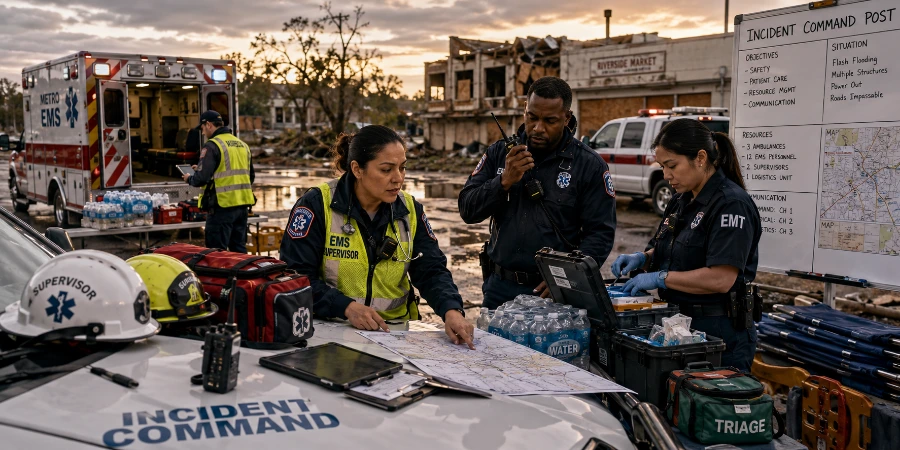
Incident command gives that structure a shared shape. The Incident Command System assigns responsibility for command, operations, planning, logistics, and finance or administration, depending on the size of the event. A basic EMS provider does not need to manage every section, but they need to know where they fit. That knowledge prevents freelancing, duplicated work, and unsafe self-deployment.
Chain of command under pressure
Chain of command matters most when crews feel pressure to act fast. A provider may see an urgent need, yet the correct action still has to match the incident objectives. Supervisors use those objectives to decide who enters a scene, where ambulances stage, which patients move first, and when crews rotate out. Clear assignments protect patients because every responder can account for their location, task, and limits.
Common language across agencies
Common language keeps agencies from guessing at each other’s meaning. Fire, EMS, law enforcement, hospitals, emergency management, and public health may all work the same event. Plain terminology reduces confusion when crews come from different counties or disciplines. A simple phrase such as “report to staging” works better than local shorthand that visiting teams may not understand.
Moving From EMS Basics to Advanced Field Judgment
Disaster scenes often expose the gap between task completion and field judgment. EMTs who want deeper ALS preparation can compare the next training step through Paramedic Courses, especially when long incidents require broader assessment, coordination, and transport decisions.
Resource Management Decides What Care Can Continue
Resource management can decide whether care continues for hours or fails after the first wave. Disaster scenes consume ambulances, oxygen, fuel, medications, PPE, stretchers, radios, and personnel faster than routine calls. Command staff must identify resources, request them, track them, recover them, and demobilize them when the mission changes. Field providers support that process by giving accurate status updates instead of vague estimates. They also help by documenting patient movement, equipment use, and unit availability before details disappear in the pace of the incident.
Staging, tracking, and demobilization
Staging areas exist for control, not convenience. Crews that bypass staging can block access, lose accountability, or drain resources from higher-priority needs. A disciplined crew reports availability, waits for assignment, and brings only the equipment needed for the task. That patience can feel unnatural during a crisis, but it keeps the response coordinated.
Triage when resources keep changing
Triage also depends on resource awareness. A provider may know how to recognize immediate threats, but disaster triage asks a harder question: who benefits most from the resources available right now? That decision can change as transport routes open, hospitals update capacity, or additional units arrive. Strong crews keep reassessing instead of treating the first triage tag as a permanent label.
Communication Must Survive Bad Conditions
Communication becomes fragile when disasters damage normal systems. Power failures, wind noise, overloaded cell networks, debris, and distance can all interfere with messages. A common operating picture depends on reliable updates from the field to command and from command back to crews. EMS providers contribute by reporting what they can verify, naming uncertainty clearly, and avoiding radio traffic that does not change decisions.
Radio discipline and backup communication
Radio discipline also protects patient care. Long messages can block urgent transmissions, especially when multiple units compete for airtime. Short updates should identify the unit, location, need, and immediate risk. Face-to-face briefings, written notes, redundant channels, and runners may become necessary when technology fails.
Public messaging and patient behavior
Public messaging affects EMS even when providers do not issue alerts themselves. Evacuation instructions, shelter information, road closures, and hazard warnings shape where patients go and when calls arrive. Conflicting messages can create avoidable surges or send vulnerable residents toward unsafe routes. Providers should know how their agency receives official updates and avoid passing unverified information to patients or families.
Personal Readiness Protects the Crew and the Community
Personal readiness begins before the shift. A provider who has no family plan, fuel, medications, childcare backup, or rest strategy may struggle to stay available during a long event. Disaster work can extend beyond a normal tour, and responders may worry about their own homes while caring for others. Readiness does not remove that stress, but it reduces preventable distractions.
Fit-for-duty under disaster conditions
Fit-for-duty judgment belongs in disaster response as much as clinical skill. Fatigue, heat, dehydration, emotional strain, and poor nutrition can weaken decision-making. Crews need to rotate, hydrate, eat, and report safety concerns early. A provider who pushes past safe limits can become another problem for the incident to manage.
Responder safety also includes recognizing hazards beyond the patient. Floodwater, unstable structures, downed power lines, smoke, chemical exposure, violence, and contaminated debris can turn a rescue into a second emergency. PPE only works when the crew selects the right protection, wears it correctly, and understands its limits. The safest providers keep scene size-up active throughout the call, not just during arrival.
Lessons Recent Disasters Keep Reinforcing
Recent disasters have shown that communication and staffing weaknesses can shape outcomes. Hurricane Ian highlighted how damaged infrastructure and heavy data demands can slow the movement of useful information. The Maui wildfire reviews pointed to needs such as clearer roles, stronger staffing, better redundant notification systems, and improved situational awareness. The lesson for EMS students is direct: disaster response fails when plans exist only on paper.
Recent events also show that equipment details matter. Radios, earpieces, breaching tools, PPE, batteries, chargers, printed maps, and backup documentation can affect field work. Crews should know what their unit carries, where it sits, and how to operate it under stress. A tool that no one can find quickly has little value during the first operational period. Small checks before deployment can prevent larger failures once weather, noise, darkness, or crowd movement limits access.
Disaster response also requires humility. A provider may arrive with strong clinical skills, but the scene may need transport coordination, shelter support, triage assistance, or patient tracking more than advanced interventions. The best response mindset asks, “What assignment supports the incident objective right now?” That question keeps the provider useful even when the task feels less dramatic than direct patient care.
How Students Can Build Disaster Thinking Early
Students can build disaster thinking early by treating every scenario as part of a system. A routine crash can involve traffic control, scene safety, family communication, hospital destination decisions, and documentation. A simulated mass-casualty scene can teach triage, but it should also teach staging, radio brevity, accountability, and handoff discipline. Those habits transfer into larger incidents. They also help students see that disaster response is not a separate personality type; it is routine EMS discipline applied under heavier pressure.
Florida adds a practical layer to that training. Storm seasons, heat events, evacuation zones, tourist traffic, older residents, and coastal geography can complicate response plans. Future EMTs and paramedics should understand that local risk profiles shape the way agencies prepare. A provider who knows the community can anticipate problems before the first surge reaches dispatch.
At EMS Ricky in Fort Myers, Florida, staff stays current on developments related to disaster response so students can connect classroom concepts with real operational expectations. Course work should help future providers understand both patient care and system behavior. Disaster response rewards people who can follow command, communicate clearly, conserve resources, and stay ready for long shifts. Those skills make the difference between simply arriving at a disaster and functioning well inside one.
FAQ
Do EMS providers need to know incident command if they are not supervisors?
Yes, EMS providers need a working understanding of incident command even when they do not hold command roles. The system tells them who gives assignments, where to report, how resources move, and how information should travel. Providers who understand the structure can work faster because they waste less time guessing.
What is the biggest communication mistake during disaster response?
One common mistake involves sending information that sounds urgent but lacks usable detail. Command needs location, number of patients, hazards, resource needs, and changes in access or safety. A short, accurate update often helps more than a long description of the whole scene.
Why does personal readiness matter for EMS providers?
Personal readiness affects whether a responder can report, focus, and remain available during a long incident. A provider who has planned for family needs, transportation, medications, and rest has fewer preventable distractions. Agencies still carry responsibility for safe operations, but individual preparation supports the whole response.
How can EMS students practice disaster response skills?
Students can practice disaster skills through scenarios that include command structure, staging, triage, radio updates, and patient tracking. Tabletop exercises help students think through decisions before stress rises. Practical drills then show whether communication, equipment habits, and teamwork hold up under pressure.

Lawrence Arfmann is a veteran fire service educator and EMS leader with more than 25 years of frontline experience. He retired as Division Chief of EMS and Health & Safety for the Lehigh Acres Fire Control & Rescue District and is currently Program Director at Ricky Rescue Training Academy, where he develops curriculum for Florida’s fire and EMS professionals.
Lawrence holds a Master’s in Public Administration from Columbia Southern University and a Bachelor of Applied Science in Public Safety Administration from Edison State College. He is a certified paramedic and Florida Certified Firefighter with state credentials dating back to the 1990s.
Lawrence has been recognized with multiple performance honors and continues to teach fire science courses at the academy level. He is also an active member of the Florida Fire Chiefs’ Association and the International Association of Fire Chiefs.