The patient of the future is already riding in today’s ambulances. In Florida, that shift matters because the state has more than five million residents age 65 and older. Many of those patients live with layered medical, mobility, medication, and communication needs. EMS students who understand that reality can see geriatric care as a core part of modern field work, not a separate chapter near the end of training.
Older patients do not simply bring more birthdays to an emergency scene. They often bring several active diagnoses, long medication lists, implanted devices, hearing loss, vision changes, memory problems, fall risk, and different goals for care. A chest pain call, a fall, or shortness of breath can turn into a broader investigation within minutes. That change affects assessment, scene communication, transport decisions, documentation, and teamwork with family members or facility staff. EMS education now has to prepare students for complexity before they meet it at 2 a.m. in a living room.
Why Aging-Patient Readiness Belongs in EMS Training
Older-adult calls test assessment discipline, communication control, medication awareness, and patient advocacy. Students comparing entry-level and advanced EMS paths can use this topic to think carefully about whether the EMT Program or later paramedic training best fits their next step.
- Geriatric calls often combine medical, trauma, mobility, and social concerns.
- Medication review and baseline questions can change the clinical picture quickly.
- Communication technique matters when hearing, vision, or cognition affects history-taking.
Why Aging Changes the EMS Call Before the Ambulance Arrives
Florida’s age profile gives EMS providers a preview of where the profession is heading. State data for 2025 lists 4,484,360 residents ages 65 to 84 and 611,902 residents age 85 and older. That places more than one in five Floridians in older-adult age groups. National census reporting shows the same broad direction, with the U.S. population age 65 and older continuing to grow faster than younger groups. For EMS, these numbers translate into more calls where age-related physiology and social context matter immediately.
An older patient may call 911 for weakness, but weakness can reflect infection, dehydration, stroke, medication effects, low blood sugar, cardiac rhythm problems, or unsafe living conditions. A minor crash may involve blood thinners, brittle skin, balance problems, or delayed pain reporting. A lift assist may reveal repeated falls, poor lighting, missing mobility equipment, or caregiver exhaustion. The future patient, in practical terms, often needs broader thinking than the complaint written on the dispatch screen.
The Medical Picture Is Getting More Layered
Older adults commonly live with several chronic conditions at the same time. Hearing loss, cataracts, chronic lung disease, diabetes, depression, dementia, arthritis, and cardiovascular disease can overlap in one person. EMS providers must avoid anchoring on the most visible problem when a quieter issue may drive the emergency. A patient who fell in a hallway may also have pneumonia, medication dizziness, dehydration, or an irregular heartbeat. The call may start with one complaint, yet the assessment often has to search for several connected causes.
Falls Often Signal More Than Trauma
Falls deserve special attention because they sit at the intersection of injury, frailty, home safety, medication use, and independence. National EMS data lists falls as the largest reported injury category in recent annual reporting. CDC data describes falls as the leading injury concern for adults age 65 and older. A provider who treats the fall only as a possible fracture may miss the reason the patient fell.
Florida’s own public health guidance frames falls as a major threat to independence for older residents. The EMS response can uncover repeated falls, poor footwear, lack of grab bars, vision trouble, dizziness after new medication, or a caregiver who cannot safely help anymore. Students should learn to ask what changed before the fall, not only where the pain started afterward. That question can turn a routine transport into a better patient handoff.
Medication Lists Can Change the Meaning of Symptoms
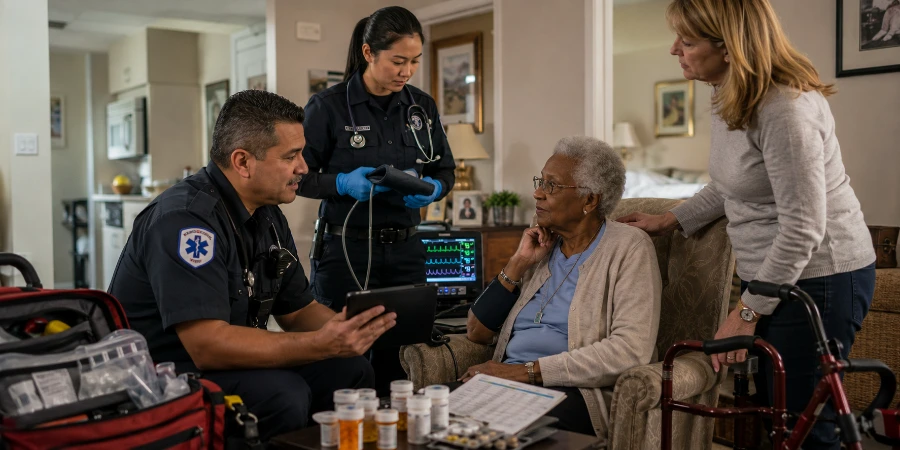
Medication history becomes more important as patients age. Blood thinners can raise concern after even a low-height fall, and sedatives can cloud mental status. EMS providers do not diagnose every medication effect in the field, but they can collect the list, ask about recent changes, and document what family or facility staff report.
Students should practice medication review as a scene skill, not paperwork after the call. Pill bottles, pharmacy packets, discharge papers, and caregiver notes often tell a clearer story than the patient can provide during distress. Medication allergies, anticoagulants, insulin, opioids, cardiac drugs, and recent antibiotics deserve careful attention. A clean medication picture can change triage urgency and reduce confusion at transfer of care.
Build the Assessment Habits These Calls Demand
Aging-patient calls reward providers who can slow the scene down without delaying care. Students preparing for EMS work can review the application process and plan training around the skills that show up repeatedly in real patient care.
Communication Becomes Clinical Care
Communication with older adults often requires more than a louder voice. CDC health literacy guidance notes that cognition, vision, and hearing changes can affect how older adults receive and use health information. EMS providers may need to slow the pace, face the patient, reduce background noise, confirm hearing aids or glasses, and use plain language. These steps help the crew collect more accurate information and reduce fear during a stressful encounter. They also keep the patient from feeling talked around while others discuss the emergency.
The scene can make communication harder. A patient may feel embarrassed after a fall, frightened by shortness of breath, confused by a sudden infection, or overwhelmed by several people asking questions. Good EMS communication keeps the patient involved whenever possible and uses caregivers as supporting sources rather than automatic replacements.
Cognitive Changes Require Careful Baselines
Confusion does not always mean dementia, and dementia does not make every new symptom routine. EMS students need to learn the difference between a known baseline and an acute change. A family member saying “she is always forgetful” does not answer whether the patient recognizes relatives today, walks normally, eats normally, or speaks normally. The most useful question often asks what the patient could do yesterday.
Delirium, infection, low oxygen, stroke, hypoglycemia, dehydration, pain, and medication effects can all change behavior. Crews should document who provided the baseline and what changed. That detail can help the receiving team separate chronic memory loss from a new emergency. It also protects the patient from having serious symptoms dismissed as ordinary aging. A careful baseline can make the difference between a vague report and a useful clinical handoff.
Where EMS Training Has to Adapt
Modern EMS training must connect geriatric knowledge to live decisions. Students need repeated practice with older-patient scenarios that include incomplete histories, noisy homes, uncertain medications, mobility barriers, and family dynamics. The national direction toward people-centered, integrated, data-informed EMS supports that shift. The classroom still matters, but scenario work helps students feel the pressure and ambiguity of real calls.
At EMS Ricky in Fort Myers, Florida, staff stays current on developments affecting EMS education, including how aging trends shape patient assessment and field readiness. For students, that means geriatric care should feel woven into airway, cardiac, trauma, medical, and communication training. Older patients appear in all those categories. The strongest providers learn to see the patient’s whole situation without losing sight of immediate threats.
The table below turns the aging-patient trend into practical EMS training priorities. Place it after the section titled Where EMS Training Has to Adapt, before the subsection titled Assessment Practice Needs Realistic Friction.
| Older-patient reality | What it can mean on scene | EMS student skill to practice |
|---|---|---|
| More Florida residents are entering older-adult age groups. | Routine EMS calls increasingly involve age-related physiology, mobility limits, and caregiver context. | Treat geriatric assessment as a normal part of medical, trauma, cardiac, and respiratory scenarios. |
| Falls can reflect injury and an underlying medical change. | A fall may involve medication effects, infection, dehydration, poor vision, or home hazards. | Ask what changed before the fall, then reassess pain, mental status, glucose, stroke signs, and medication risks. |
| Multiple chronic conditions can overlap during one emergency. | Weakness, dizziness, shortness of breath, or confusion may have several connected causes. | Avoid early anchoring and build a structured assessment around vitals, history, medications, and reassessment. |
| Hearing, vision, and cognitive changes can affect communication. | The patient may miss questions, misunderstand instructions, or rely on family to fill history gaps. | Face the patient, reduce noise, use plain language, confirm assistive devices, and verify understanding. |
| Care settings affect the quality of available information. | Home, assisted living, and nursing facility calls may provide different baseline details and records. | Identify who knows the baseline, collect medication records, and document who supplied key history. |
Assessment Practice Needs Realistic Friction
A clean textbook case rarely prepares students for an older patient sitting on a bathroom floor at midnight. The crew may have limited space, anxious relatives, loose rugs, poor lighting, and a patient who cannot explain the event clearly. Training scenarios should include those barriers because they affect safety and decision-making.
Realistic geriatric scenarios should require a full assessment, not a single protocol reflex. Students can practice checking mental status, medication clues, injury risk, oxygenation, glucose, stroke signs, pain, temperature, and transport needs in one unfolding case. That approach builds pattern recognition without encouraging shortcuts. It also teaches students to reassess when the first explanation does not fit. Reassessment matters because older patients can deteriorate subtly before vital signs look dramatic.
Family, Facilities, and Handoffs Matter More
Older patients often move through emergencies with other people attached to the call. A spouse may know the medications, an adult child may know recent appointments, and facility staff may know baseline mobility. EMS providers need to gather those details quickly without letting the scene become chaotic. Clear role control helps the crew respect everyone while keeping patient care organized.
Handoffs carry special weight with medically complex older adults. The receiving team needs the chief complaint, baseline function, recent changes, medications, fall details, vital signs, assessment findings, and who provided key history. A vague report such as “elderly fall” gives little clinical value. A precise handoff can explain that the patient had three falls this week, started a new sleep medication, seemed more confused today, and takes an anticoagulant. That type of report gives the next team a clinical timeline, not just a label.
What Future EMS Providers Should Build Now
Students who want long EMS careers should treat geriatric readiness as a professional advantage. Older-patient calls reward patience, structured thinking, calm communication, and disciplined reassessment. These habits help on every call type, but they become essential when the patient has multiple conditions and a limited ability to explain symptoms. Strong providers do not rush past the details that make the case make sense. They learn to balance immediate threats with the slower detective work older-adult calls often require.
The best preparation starts with repeated exposure to realistic cases. Students can practice asking baseline questions, reading medication labels, giving concise handoffs, and adapting speech for hearing or cognitive challenges. They can also review fall prevention concepts, chronic disease patterns, and common reasons older adults decline quickly.
FAQ: Aging Patients and EMS Careers
Why should EMS students care about aging population trends?
Aging trends affect the kinds of calls EMS providers answer every week. More older residents mean more encounters involving falls, weakness, chronic disease, medication concerns, and communication barriers. Students who prepare for those realities enter the field with stronger assessment habits and better patient awareness.
Are geriatric calls mostly low-acuity calls?
No, that assumption can create risk. Some older-adult calls involve non-emergent needs, but others hide serious illness behind vague symptoms such as weakness, dizziness, confusion, or a fall. EMS providers need a structured assessment because older patients may not show classic symptoms.
What communication skill matters most with older patients?
The most useful skill is confirming understanding without making the patient feel rushed or ignored. Providers should face the patient, reduce distractions, use plain language, and check whether hearing aids or glasses are available. Caregivers can help, but the patient should remain part of the conversation whenever possible.
How does this topic affect EMT and paramedic training?
Training needs to include geriatric scenarios across medical, trauma, cardiac, respiratory, and communication modules. Students should practice full cases with medication lists, baseline questions, family input, and mobility limitations. That approach prepares new providers for the complexity they will see in Florida EMS systems.

Lawrence Arfmann is a veteran fire service educator and EMS leader with more than 25 years of frontline experience. He retired as Division Chief of EMS and Health & Safety for the Lehigh Acres Fire Control & Rescue District and is currently Program Director at Ricky Rescue Training Academy, where he develops curriculum for Florida’s fire and EMS professionals.
Lawrence holds a Master’s in Public Administration from Columbia Southern University and a Bachelor of Applied Science in Public Safety Administration from Edison State College. He is a certified paramedic and Florida Certified Firefighter with state credentials dating back to the 1990s.
Lawrence has been recognized with multiple performance honors and continues to teach fire science courses at the academy level. He is also an active member of the Florida Fire Chiefs’ Association and the International Association of Fire Chiefs.