Why Spring Can Hit EMS Systems Harder Than It Looks
Spring changes how communities use public spaces, roads, schools, parks, and water. EMS crews see that shift before summer officially arrives. Longer daylight hours bring tournaments, festivals, road trips, boating, yard work, and outdoor jobs. The total call volume may not rise evenly across every region. The pattern still changes enough to reward early planning. National EMS data from 2024 showed more than 60 million EMS activations nationwide. That scale makes even modest seasonal pressure meaningful for local agencies.
Spring EMS Readiness Starts With Training That Transfers to the Field
Seasonal call patterns give future providers a practical way to connect classroom preparation with field judgment. Ricky Rescue’s EMT Program helps students build the assessment habits, communication skills, and scene awareness that matter when outdoor events, weather, trauma, and routine medical calls overlap.
- Connects patient assessment to real seasonal risks like heat, falls, crashes, and respiratory complaints.
- Reinforces scene-size-up thinking before crowded events or changing weather complicate access.
- Helps students understand why preparation matters before high-volume weekends arrive.
| Seasonal planning point | Fact-checked context |
|---|---|
| National EMS scale | More than 60 million EMS activations occurred in 2024. |
| Falls | Falls accounted for more than 3.5 million injury-related EMS events. |
| Motor vehicle crashes | Crashes accounted for more than 1.8 million injury-related EMS events. |
| Event medicine | Mass gatherings produce measurable patient presentation and transport rates. |
| Heat readiness | HeatRisk now gives health-based forecasts up to seven days ahead. |
The Calls That Rise When Communities Move Outdoors
Spring does not create one neat category of emergency. It creates more exposure across many ordinary call types. A student may picture festivals and athletic fields first. A field provider sees stair falls, traffic crashes, respiratory complaints, dehydration, and altered mental status. That variety makes spring a useful season for sharpening assessment skills. Crews need pattern recognition without turning every patient into a seasonal stereotype.
Falls, trips, and event-site injuries
Falls remain one of the most common injury patterns in EMS documentation. Spring adds new settings where those falls happen. Patients trip over tent stakes, curbs, bleachers, wet grass, boat ramps, and uneven sidewalks. Older adults may return to gardens, patios, churches, markets, and community events. Event crowds can also hide hazards until someone goes down. A good provider studies the surface, the mechanism, and the patient together.
Crashes, bikes, and motorcycles
Warmer weather puts more vehicles and vulnerable road users together. Spring brings motorcycles, bicycles, scooters, pedestrians, delivery traffic, and weekend travelers into tighter spaces. National data shows motor vehicle crashes remain a major EMS injury category. Motorcycle fatalities also remain a serious traffic safety concern nationwide. EMS students should expect high-energy mechanisms during pleasant-weather travel periods. Scene safety, traffic control, helmet assessment, and rapid size-up matter immediately.
Sports and recreation calls that do not wait for summer
Spring sports create fast, crowded, and sometimes confusing response environments. Baseball fields, basketball courts, soccer complexes, gyms, and cycling routes all generate calls. National injury data shows millions of emergency visits involve sports and recreational equipment. Many patients still present with minor complaints, but subtle injuries can matter. Head impacts, exertional symptoms, asthma, dehydration, and fractures deserve careful assessment. New providers should resist dismissing a complaint as “just sports.”
Heat Illness Starts Before Many New Providers Expect It
Heat illness does not wait for the hottest month. Early warm weekends can catch athletes, workers, and event crowds before bodies adjust. People often underestimate risk during spring because the calendar still feels mild. EMS crews may encounter syncope, cramps, weakness, confusion, vomiting, or collapse. Recent CDC reporting shows heat-related emergency visits increased during warm-season periods in several regions. The trend matters because spring planning can reduce preventable field surprises.
Why HeatRisk belongs in EMS planning
HeatRisk gives EMS planners a practical look beyond the basic temperature forecast. The index considers local risk, heat duration, daytime heat, and nighttime recovery. It also gives health-based guidance up to seven days ahead. That longer window helps agencies plan staffing, water access, shade, and standby coverage. Students can learn from this tool without treating it as a protocol. Good clinical judgment still starts with the patient in front of them.
What students should watch for in the field
Heat illness often blends with other problems during outdoor events. A dizzy patient may also have low blood sugar, dehydration, anxiety, intoxication, or cardiac symptoms. A confused athlete may need more than water and reassurance. Students should note exertion level, clothing, medications, age, shade access, and symptom timing. Mental status changes deserve special attention during hot-weather calls. Early recognition helps providers communicate clearly and request appropriate support.
Move From Seasonal Awareness to Course-Ready EMS Skills
Spring readiness depends on more than memorizing common call types. Students preparing for EMT training can review Ricky Rescue’s EMT Skills Lab Mastery guide to connect patient assessment, airway practice, bleeding control, and scenario thinking with the kinds of outdoor incidents described here.
Outdoor Events Need Planning Before the First Patient Walks Up
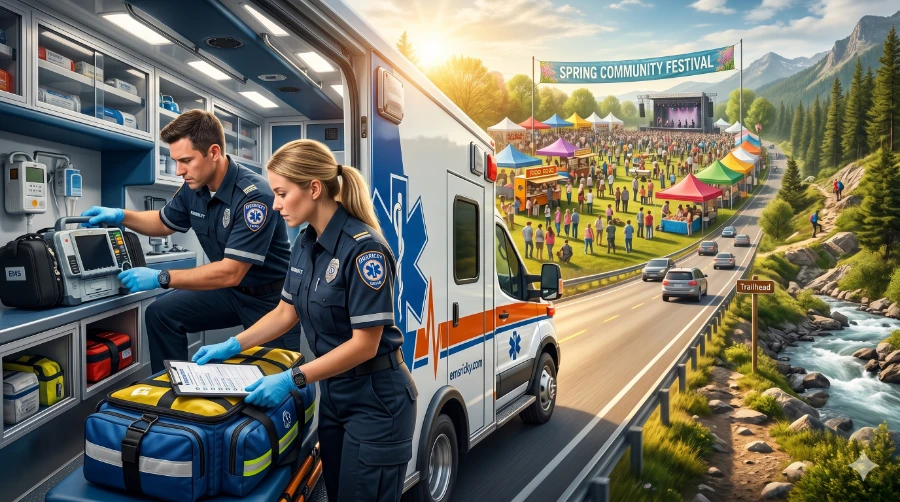
Mass gatherings need more than a crew parked near the gate. Events create predictable pressure on staffing, supplies, space, and communication systems. Research on mass gatherings shows measurable patient presentation rates and transport rates. Most patients may need basic care, yet one serious case can strain weak planning. The best event plan starts before the first attendee arrives. A strong plan helps crews find patients, move patients, document care, and coordinate transport.
Staffing is only one part of readiness
Extra personnel help, but staffing alone cannot fix poor event design. Crews also need access routes, clear radio channels, first-aid space, and restocking plans. AED placement, shade, water, lighting, and crowd barriers can affect patient care. Walking teams may reach patients faster than ambulances inside dense crowds. Supervisors should know where ambulances can enter and exit. Students should learn that logistics often shape clinical speed.
Medical direction and post-event review
Event medicine benefits from clear medical leadership and defined care goals. A medical director can help match resources to crowd size, weather, risk, and location. Planning should include what crews can manage onsite and what requires transport. After the event, leaders should review patient counts, transport decisions, supply gaps, and communication problems. That review turns one busy weekend into better future readiness. Students who understand this cycle see EMS as a learning system.
Why pre-incident planning matters
Pre-incident planning prevents crews from improvising under crowd pressure. A good plan identifies hazards, likely patient locations, communication paths, and escalation triggers. It also helps responders coordinate with law enforcement, fire, event staff, and hospitals. EMS mass gathering planning often emphasizes traffic routes, medical care locations, staffing, BLS and ALS capability, prior presentation rates, and hospital transfer patterns. Those details help agencies prepare before a small issue grows larger. EMS education should treat planning as a clinical safety skill.
Spring call volume rarely comes from one single risk factor, so EMS students benefit from seeing how different seasonal triggers overlap in the field. This planning table connects common spring scenarios with the practical readiness steps that matter before a crew reaches the patient.
| Spring Scenario | Likely EMS Concerns | Readiness Focus | Student Learning Point |
|---|---|---|---|
| Community festivals and outdoor concerts | Heat illness, falls, intoxication, anxiety, dehydration, crowd-related access delays | Clear access routes, first-aid location, radio plan, patient movement strategy, restocking process | Crowd management can affect patient care as much as clinical skill. |
| School sports and recreational leagues | Head injuries, fractures, asthma symptoms, exertional collapse, dehydration | Field access, athletic trainer coordination, cooling options, parent communication, transport criteria | A minor-looking sports complaint can still require careful reassessment. |
| Early hot-weather weekends | Syncope, cramps, weakness, confusion, heat exhaustion, worsening chronic illness | HeatRisk review, shade, hydration support, crew rotation, early cooling awareness | Heat illness can appear before the peak summer season. |
| Motorcycle, bicycle, and scooter activity | High-energy trauma, helmet concerns, road rash, extremity injuries, multi-patient crashes | Scene safety, traffic control, mechanism assessment, rapid patient count, law enforcement coordination | Warm weather can increase exposure to vulnerable road users. |
| Parks, trails, lakes, and campgrounds | Falls, water incidents, allergic reactions, tick exposure, delayed access, vague location details | Local geography review, access-point awareness, bystander history, communication backup planning | Location problems can delay care before treatment even begins. |
| Spring storms and lightning-prone events | Lightning injuries, sudden crowd movement, weather exposure, delayed evacuation, responder safety issues | Weather monitoring, shelter plan, event pause rules, safe staging, communication with organizers | Weather planning belongs inside EMS readiness, not outside it. |
Weather Is an EMS Variable, Not Background Noise
Weather changes patient behavior, scene access, and responder safety within minutes. Spring events can face heat, lightning, wind, heavy rain, and sudden temperature shifts. Lightning planning deserves special attention at organized outdoor activities. National weather guidance recommends clear rules for stopping, sheltering, resuming, monitoring, and responding. Those decisions should exist before spectators crowd the field. EMS crews cannot provide good care from an unsafe scene.
Lightning strikes the United States millions of times each year. Fatalities remain limited compared with many hazards, yet severe injuries still occur. Outdoor sports, festivals, lakes, fields, and open parking lots increase exposure. Weather also changes how patients move through crowds and seek shelter. A storm can turn a controlled event into a disorderly response area. Providers should treat weather awareness as part of patient care.
Water, Parks, Trails, and Rural Edges Add Another Layer
Spring activity often spreads people beyond easy ambulance access. Lakes, pools, rivers, trails, campgrounds, and parks create different response problems. Crews may face delayed access, unclear locations, poor lighting, or limited bystander information. National drowning estimates still show thousands of fatal and nonfatal incidents each year. Children carry special risk around water, especially in busy family settings. EMS students should connect scene safety with rapid pediatric assessment.
Water calls can also affect rescuers and bystanders emotionally. A crowded lakeshore or pool deck often produces conflicting stories. One person may report submersion time, while another guesses from fear. Providers need calm questions, airway focus, and accurate handoff details. Rural trails and parks add distance, terrain, and communication challenges. Good preparation starts with knowing local geography before the call drops.
Spring Respiratory Calls Can Hide Inside “Outdoor Fun”
Spring respiratory complaints often arrive with a casual explanation. Patients may blame pollen, exercise, humidity, smoke, dust, or anxiety. Asthma affects millions of adults and children across the United States. Seasonal allergies also affect a large share of the population each year. Those facts matter because outdoor plans can expose vulnerable patients quickly. EMS students should avoid treating “allergies” as a complete diagnosis.
A wheezing patient at a festival needs a real respiratory assessment. Work of breathing, speech ability, skin signs, medication access, and trigger history matter. Heat, exertion, pollen, and crowd stress can overlap during one event. Some patients may delay seeking help until symptoms worsen. Others may arrive anxious, embarrassed, or unsure what started the episode. Clear assessment separates minor irritation from a worsening emergency.
Ticks, Bites, and Outdoor Exposure Belong in the Seasonal Picture
Ticks and insect exposures deserve a smaller but real place in spring readiness. CDC guidance identifies April through September as a highly active tick period. Blacklegged tick nymphs seek hosts during spring and early summer. Their small size can make exposure difficult to notice. Recent CDC reporting also described higher-than-usual emergency visits for tick bites in many regions. Outdoor EMS crews may encounter bites, rashes, allergic reactions, or vague illness complaints.
This topic does not need alarmist language. EMS students should simply ask better exposure questions during outdoor seasons. Camping, hiking, yard work, sports fields, pets, and wooded areas all matter. Patients may not connect symptoms with a recent outdoor activity. That missing context can weaken the handoff. A careful history helps the next clinician continue the investigation.
What High-Volume Seasons Demand From EMT and Paramedic Students
Busy seasons test habits before they test heroics. Students need steady assessment, clear communication, and local awareness. Seasonal patterns can guide preparation, but they cannot replace clinical thinking. A festival patient may have heat illness, hypoglycemia, intoxication, cardiac symptoms, or head trauma. One symptom rarely tells the entire story. New providers should build flexible thinking early.
Build pattern recognition without tunnel vision
Pattern recognition helps crews anticipate likely problems during spring events. It becomes dangerous when providers stop looking for competing causes. A collapsed runner may have heat illness, arrhythmia, asthma, dehydration, or low glucose. A dizzy concert attendee may have anxiety, intoxication, bleeding, pregnancy complications, or cardiac symptoms. Students should let the scene inform questions, not answer them. Good assessment keeps the patient larger than the setting.
Practice communication under crowd pressure
Crowds make basic communication harder than students expect. Noise, heat, music, phones, bystanders, and security staff all compete for attention. Crews need short radio reports, precise locations, and calm handoffs. A vague location inside a fairground can delay help more than a difficult procedure. Students should practice saying what matters without overtalking. Strong communication protects patients when the scene feels chaotic.
Prepare for ordinary calls during extraordinary volume
High-volume weekends still include ordinary medical complaints. EMS continues to handle weakness, chest pain, shortness of breath, syncope, altered mental status, and seizures. National EMS documentation repeatedly shows those symptoms among common patient presentations. Outdoor emergencies do not cancel routine illness. The challenge comes when routine calls stack beside event coverage and trauma responses. Students who expect that mix manage their energy better.
3 Practical Tips Before the Busy Season Starts
Review the calls your area actually gets
Local patterns matter more than national averages during field preparation. A coastal area may see water incidents, tourists, heat, and traffic congestion. A rural area may see trail injuries, farm work, storms, and longer transport distances. A city may see festivals, pedestrian injuries, dehydration, and crowded nightlife. Students should learn the seasonal personality of their service area. That knowledge makes ride time more useful and less surprising.
Treat event standby like a real clinical assignment
Event standby can look quiet until several patients appear together. Students should know supply locations, radio expectations, patient movement routes, and documentation rules. Shade, hydration, rest breaks, and crew rotation also affect performance. A first-aid tent needs organization before patients fill the chairs. Professional habits matter even when the first hour feels slow. Event coverage teaches readiness, patience, and controlled response.
Watch the weather before it becomes the call
Weather awareness gives crews time to think before conditions deteriorate. HeatRisk, storm forecasts, and lightning plans all support safer decisions. Students should know who monitors weather during event operations. They should also know where patients and crews can shelter. A weather change can alter triage, transport routes, and crowd movement. Prepared crews adjust sooner and communicate with less confusion.
Frequently Asked Questions
When does heat illness become a serious EMS concern?
Heat illness becomes a concern before peak summer during early hot weather. Outdoor labor, sports, festivals, and poor acclimatization can increase risk. EMS students should watch exertion, hydration, shade access, medications, and mental status. HeatRisk can help planners anticipate dangerous conditions several days ahead. A mild calendar date does not guarantee a low-risk scene.
Why do outdoor events need a medical plan?
Outdoor events gather people, movement, heat, noise, and access problems together. Research on mass gatherings shows predictable patient presentations and occasional transports. A medical plan organizes staff, supplies, space, and communication before problems start. It also helps crews coordinate with event staff and public safety partners. Good planning improves care before the first patient asks for help.
What spring calls should EMT students expect?
Spring calls often include falls, crashes, sports injuries, and respiratory complaints. Crews may also see heat illness, allergic reactions, water incidents, and minor event complaints. The exact mix depends on local weather, geography, and community activity. Students should prepare for both outdoor emergencies and routine medical calls. Strong assessment matters more than memorizing a seasonal checklist.
How can new EMTs prepare for event standby shifts?
New EMTs should learn the event layout before patients appear. Access routes, radio channels, supply areas, and transport points matter. They should also prepare for weather, noise, crowds, and unclear patient locations. Calm communication often matters as much as equipment during standby coverage. Event shifts reward providers who stay observant during quiet periods.
Ready for the Season, Not Surprised by It
Spring EMS readiness starts with respect for predictable change. Communities move outside, events fill calendars, and weather shifts quickly. Calls may involve trauma, heat, breathing problems, water exposure, or ordinary illness. Good providers prepare for the pattern without forcing every patient into it. EMS students who understand seasonal pressure gain better field judgment. That awareness improves ride time, clinical conversations, and early professional confidence.

Jeromy VanderMeulen is a seasoned fire service leader with over two decades of experience in emergency response, training, and public safety management. He currently serves as Battalion Chief at the Lehigh Acres Fire Control & Rescue District and is CEO of the Ricky Rescue Training Academy, a premier provider of online and blended EMT and firefighter certification programs in Florida.
Jeromy holds multiple degrees from Edison State College and the Community College of the Air Force, and is pursuing his MBA at Barry University. He maintains top-tier certifications, including Fire Officer IV, Fire Instructor III, and Fire Inspector II, and has served as a subject matter expert for a court case. He is a member or the Florida Fire Chiefs Association.
Jeromy also contributes to state-level fire safety regulation and serves on several hiring and promotional boards.